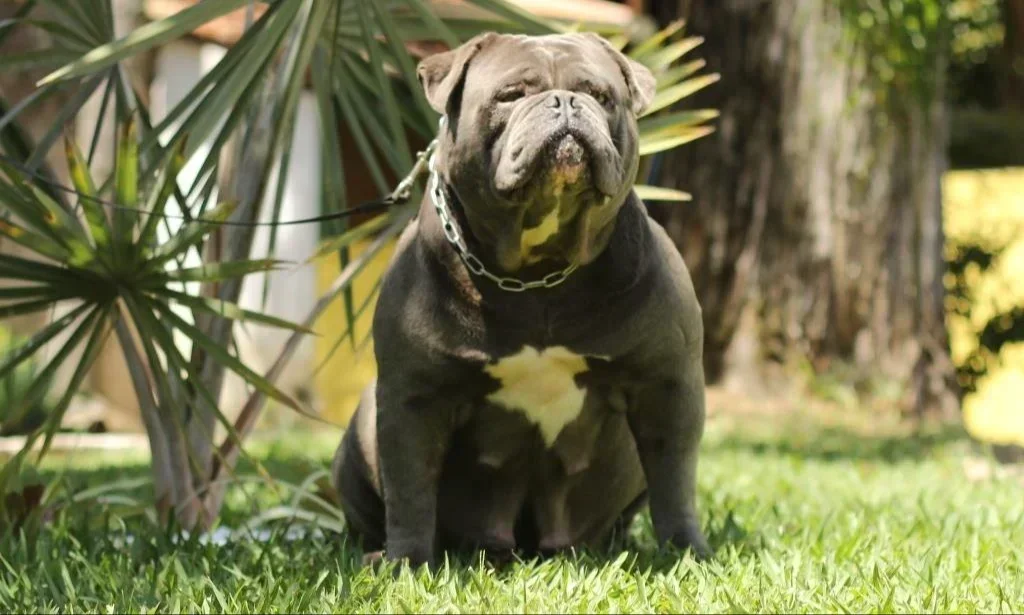
The history of the American Bulldog begins in the mountains of Tibet, where the Molossian or mastiff-type dogs arose. They descend from the great Tibetan wolf, which still exists in northern India and Tibet. The Chinese were probably the first people to breed true mastiffs; their literature contains references to large hunting dogs with short muzzles and broad jaws, around 1121 BC.
These dogs were used to hunt dangerous animals such as tigers, wild boar or bears. The hallmark of these canine monsters was always their size, their relative slowness (compared with Greyhounds and the larger Terriers) and their exceptional ability to defend themselves. Stone carvings showed a muscular, short-haired, solid dog, without the excess skin of today's Molossian breeds.
Compared with today's English Mastiff, the ancestral molosser was less than half the size, with a build similar to that of a heavy-boned American Pit Bull Terrier. There is no doubt that these dogs were also sturdy, with well-placed legs and without the dysplasia of today's show mastiffs.
Alexander the Great brought more mastiffs from India to Greece around 333 BC, and Greece was the center of mastiff breeding for 700 years, until the English dogs became predominant. In appearance, and perhaps in temperament, the dog closest to the Greek mastiff would be the Swinford Bandog, a combination of the athletic Neapolitan Mastiff, English Mastiff and Pit Bull. Swinfords have large (not huge), muscular bodies, with solid, medium-sized heads similar to a Pit Bull's.
Julius Caesar may have encountered English mastiffs when he made his first raid on England in 55 BC. Legend says he was so impressed by the ferocity of the muscular war dogs used by the Celtic tribes that he brought some back with him. Supposedly, the Celts bred the dogs and trained them to bite the muzzles of cavalry horses. The ancient Bulldogs would hold on to the horses' muzzles until the horses began to buck and throw their riders. Modern American Bulldogs and American Pit Bull Terriers capable of immobilizing a horse in this way weigh between 45 and 100 pounds (1 pound is about 0.4536 kilograms).
The ancestral British dogs were probably about the same size, and by the standards of the time these dogs were huge. Today they are known by their Latin name “Pugnaces”, and because of the way they attacked, it can be said with confidence that the Pugnaces were true Bulldogs, perhaps the first in the world. The Pugnaces were fawn with a black mask or dark brindle, colors similar to today's Bullmastiff, but the Pugnaces were much leaner. If we could go back in a time machine, people would mistake them for a large Pit Bull or a small Bandog.
Some Celtic tribes also bred their Pugnaces to hunt wild boar, which was considered a magical animal in ancient Britain. They were used together with scent hounds, since they were catch dogs and not scent dogs. The hounds would have relied on the Pugnaces' protection against boars or bears. Hunting was a mystical and religious experience for the Celts.
Around 300 AD, the Romans recognized the superiority of British dogs for use in battle. The emperor appointed a special official called the “procurator cynegii”, who worked out of Winchester. His job was to find the sturdiest, most aggressive fighting dogs in Britain and send them to Rome.
They shipped two types of mastiffs: 1- a lighter dog (well under 100 pounds) for combat in the Colosseum against bulls, wolves and small cats; 2- a heavier dog (around 100 pounds) to fight wolves, big cats and exotic challengers such as hyenas. There is evidence that the Romans actually used the name Bulldogs for the lighter dogs, as well as accounts that they were able to break the neck of a bull and were transported in iron cages.
The Romans loved these dogs so much that they gave up importing fighting dogs from Greece, which had been their main source for centuries. This must have been a blow to Greek dog breeders, because the name “Molossus” comes from a region of northern Greece called Molossia, whose name comes from a tribe called the Molossi. Even today there are two types of mastiff in Italy that descend from the first English Pugnaces: the Neapolitan, at 90 to 150 pounds, and the Cane Corso, under 100 pounds. The Cane Corso is still used by Italian farmers as a working Bulldog and probably shares ancestors with the English Bulldog, American Bulldog and Pit Bull.
Several centuries later, a new type of mastiff reached the British coast, brought to Europe by nomads called the Alani, who had been driven out of Asia by the Huns. The Alani roamed Europe and finally settled in what is now Albania, a region not far from Molossia. Their dogs became known as Alants or Alaunts in medieval England. The Alants were described as white (sometimes with dark patches around the eyes), with a large head and a short muzzle, and they were excellent for hunting wild boar. This was the second type of Bulldog to be bred in Britain. The modern American Bulldog fits the description above perfectly. The Alant may be the most direct ancestor of the American Bulldog, Pit Bull, Sour Mug, Spanish Bulldog and Dogo Argentino. There are direct descendants of the Alants alive today that are less well known. In the mountainous regions between Turkey and India there are large white mastiffs that are still used in fights against bears.
English dogs were subjected to much greater performance pressure than their European cousins. Breeding selection was not done directly by people through conformation judging, as it is today with show dogs, but by selecting those that performed best in fights with other animals, and this selection lasted more than 1,450 years. Over this vast period of time, a dog of unbelievable courage emerged: the Olde English Bulldogge.
There were accounts that these dogs could hold on to a bull's lips even after their entrails had been torn out. Butchers sometimes subjected their Bulldogs to unimaginable cruelty to prove their fighting ability, even cutting off their legs while the dog held on to its opponent, until all its blood had drained. A great Bulldog would hold its grip even when mutilated. Performance Bulldogs and Pit Bulls are among the bravest animals that have ever lived on Earth. There are accounts that these dogs are braver than lions, since a lion does not normally attack an adult elephant, whereas a fighting Bulldog would attack if ordered to; it might not survive, but it would die trying.
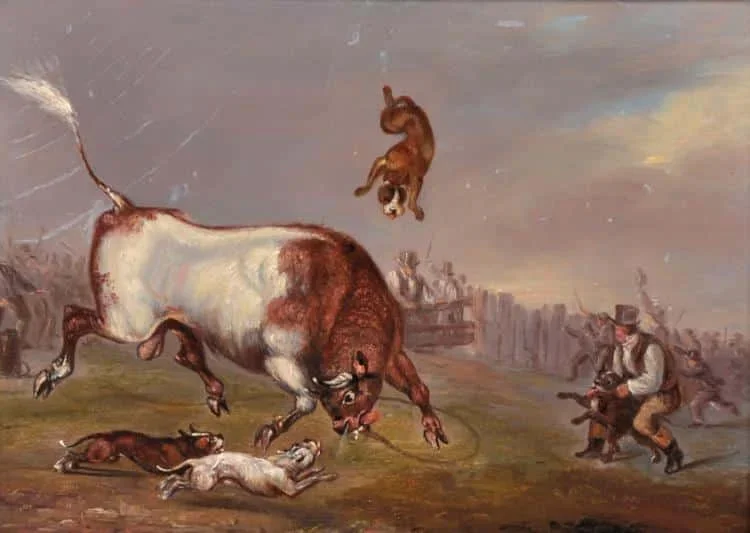
In the Elizabethan era, some Bulldog lines became more specialized for fighting, being smaller and more agile. When bull-baiting became more popular, Greyhounds and Terriers were probably added to Bulldogs to increase speed and reduce size. One sign of the superiority of the Olde English Bulldogge was its export to every part of Europe, even though those countries already had their own lines. Charles V of Spain imported 400 dogs from England to prepare for war against France in 1518. These dogs destroyed the French war dogs and became famous throughout Europe. In 1588, Olde English Bulldogges were exported not only to Spain but also to Cuba and Florida, where they were used in violent sports. They were the first Bulldogs in America, and possibly an ancestor of today's American Bulldog.
There are two reasons for the variety of types found in American Bulldogs: 1- the dogs were used not only for bull-baiting but also for bear-baiting, activities that required different sizes and builds; 2- uniformity of appearance is a modern phenomenon found in show dogs; 150 years ago, before dog shows, all breeds showed great variety, since dogs were bred for performance and no one cared about looks.
Within the Olde English Bulldogge breed, this variety was more pronounced in the 16th and 17th centuries, because bear-baiting was at its peak in England, which required larger, sturdier dogs, different from those that fought bulls. So the two lines grew apart during this period. In 1609 an English playwright mentioned “BullDogs” and “BearDogs” as if they were separate breeds. The larger ones, called “BearDogs”, were also called “BanDogges” in the 17th century. BanDogges were described as huge, ugly and fearsome. Besides bear-baiting and guard work, they were used in fights against lions as the English appetite for blood sports grew. They were sometimes put in arenas against a man armed with a spear, no doubt a good test of the breed's guarding ability.
In 1835, fights with bulls, bears and other animals were banned in England, and these lines declined rapidly. As a result, dog fighting became extremely popular, and it was only banned at the turn of the 19th century. In dog fighting, Terrier blood was supposedly needed to eliminate the Bulldog's tendency to grab and hold, which made dog fights boring. In addition, the smaller size increased the dogs' stamina and agility and made fights last longer. The Terriers most likely used were the extinct English White Terrier and the Fox Terrier. Bulldogs were crossed with Terriers to make Pit Bulls or with Pugs to make “Sour Mugs”, and as a result they were becoming extinct in their country of origin. Many were exported to America to make Boxers, American Bulldogs and Pit Bulls.
In an attempt to save this symbol of English courage, the first dog show for Bulldogs was held in 1860. The standard used was a slightly exaggerated form of the original working dog; these dogs were supposed to have long legs and look like short-muzzled American Bulldogs or medium-muzzled Boxers. The difference between modern standards and the lines of that time is that breeders took breeding so seriously that the dogs were functional first, with concern for show conformation coming second.
In 1870 the intermediate “Sour Mug” types began winning shows, dogs that clearly did not have the build of functional dogs. Since then, most show Bulldog lines have become more and more exaggerated and less healthy, while a minority of breeders kept producing functional Bulldogs. As a result, there was strong pressure for the standard to allow an “extreme” appearance. A fierce debate took place at the end of the 19th century about changing the standard, just as happens in Bulldog communities today.
Today in America, a few breeders want only enough breed type to tell American Bulldogs apart from American Pit Bull Terriers, while most want really big, extreme dogs, truly like giant English Bulldogs. At the end of the 19th century, breeders of functional Bulldogs in England challenged “Sour Mug” breeders to long-distance walking trials. The question was not whether the extreme “Sour Mugs” could beat the less extreme ones, but that they would not even be able to finish a 10-mile course. The first challenge ended with the “extreme” Bulldog collapsing after two miles. These demonstrations of uselessness changed nothing, since inbreeding of deformed dogs kept increasing. The image of the functional dog was less and less associated with English show dogs.
In 1898 the majority of breeders, who bred show dogs, won the debate, and the English standard deliberately eliminated the depiction of the functional Bulldog and made other changes that allowed show breeders to quickly turn the “warriors” of old into the caricature of today's English Bulldogs. And to transform their dogs even faster, the Pug was extensively reintroduced for about another half century. The introduction of the Pug was blamed for the loss of functionality of the old English Bulldogs (Olde English Bulldogges).
In the 17th and 18th centuries, English settlers brought their performance Bulldogs and BearDogs to America for three reasons: to control livestock, to hunt wild animals and for personal protection. These settlers did not have the vanity to use their dogs in fights against bears and bulls for entertainment, as their cousins in the Old World did. So they bred their Bulldogs to be less violent and easier to train.
These dogs became known by many different names, depending on regional varieties. Most of the names were combinations or variations of four words, “Old”, “English”, “White” and “Bulldog”, such as Old English White, White English Bulldog, Old English or simply (and most commonly) Bulldog. Dogs from some lines were neither white nor predominantly white. These dogs were called “Brindle Bulldogs”. In the southern United States, the Black community kept the “Brindle Bulldogs”, and there is still a Black breeder in Ohio today who keeps this tradition alive and still breeds brindle and fawn Bulldogs.
Out of prejudice, white farmers thought white Bulldogs were more intelligent than the colored version. There are three valid reasons for breeding white Bulldogs: 1- white is a highly recessive color and would be a safeguard against crossbreeding; 2- the white color was more visible when hunting wild boar, especially at night; 3- by breeding white dogs they were returning to the breeding of the Alants. On the other hand, there are many health problems associated with white dogs, and it is a poor color for a guard dog. John D. Johnson named the breed “American Bulldog”.
During Mr. Johnson's childhood and teenage years, in the 1920s and 1930s, these dogs were known as Pit Bulldogs in northern Georgia, because they were sometimes used to fight dogs and large wild animals in pits. He was the first person to sell them to the general public in the 1950s, so the name he used, “American Pit Bulldog”, was the first name to become widely used outside the rural American South. In 1985 Johnson realized that people were confusing this breed with the American Pit Bull Terrier, so he changed the breed's name to American Bulldog. Mr. Johnson's friend Joe Painter also contributed to the name change. In the early 1970s, several breeders set out to rebuild and rescue the breed, names that are found in today's pedigrees, such as Scott, Williamson, Bailey, Tate and Johnson. They were responsible for preserving the Old English Bulldog and keeping the breed alive to this day. Three main American Bulldog lines came into being: Johnson, Scott and Painter. 1- The Johnson line is characterized by heavy bone and a large body, large square heads, generally a short muzzle, a definite undershot bite, facial wrinkles, elbows turned slightly outward and a very broad chest. This type carries “Sour Mug” blood, which makes it look more distant from the American Pit Bull, and it is known for having more “breed type”. 2- The Scott line is a little lighter in type than the Johnson type, with a longer muzzle; they have a slight undershot bite or may have none at all. 3- The Painter line has longer legs and occasionally a shorter muzzle than the Scott type, but with a similar structure. Most Painters were developed as fighting dogs and may have a more aggressive temperament than other dogs from performance lines.
The founders of the breed, Scott and Johnson, bought dogs from each other and crossed dogs from their lines. Painter bought dogs from both Johnson and Scott. Johnson started breeding in the 1930s, Scott in the 1960s and Painter in the 1970s. Only Johnson and Scott kept breeding the breed, and these two lines later became the basis for the breed standard.
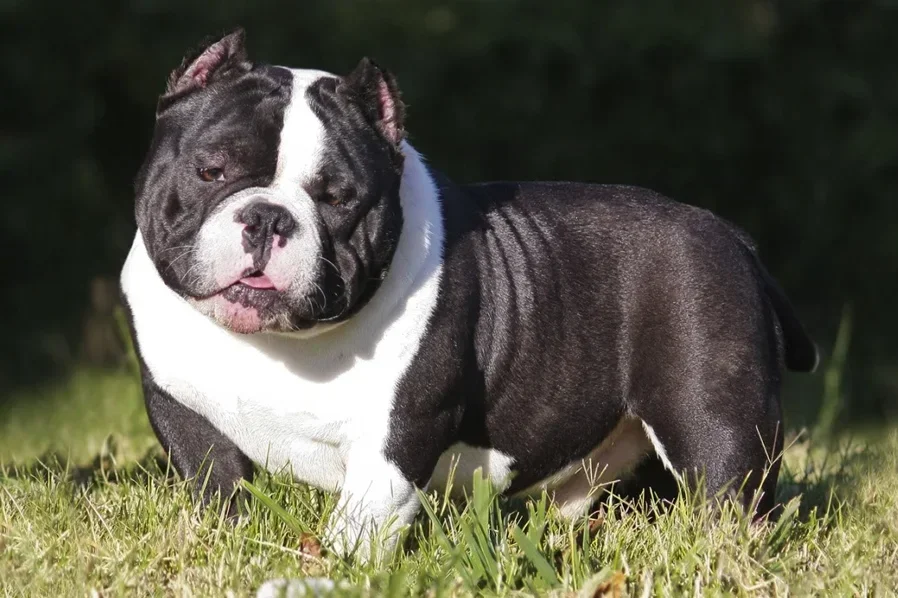
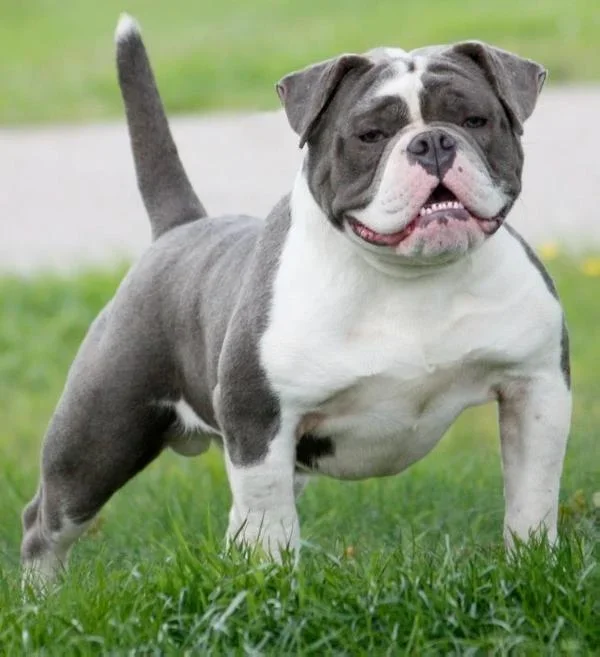
In the early 1980s there was a conflict between Scott and Johnson, who became less friendly after the NKC (National Kennel Club) began holding shows for the breed in the United States, where one type began to beat the other. After much discussion in the breeder community, two different standards were created for the breed: the line of lighter, performance dogs had its type recognized as “Standard” (Figure 1), and the heavier dogs were recognized as the “Bully” type (Figure 2).
Figure 1: Standard-type American Bulldog
Figure 2: Bully-type American Bulldog