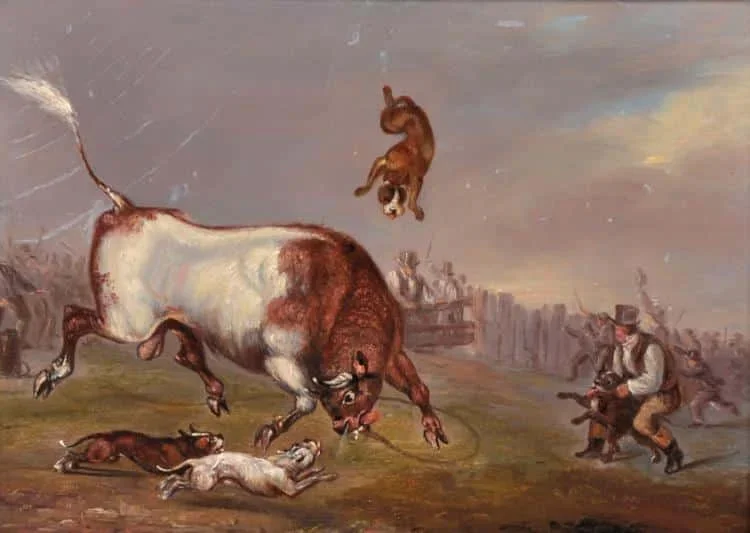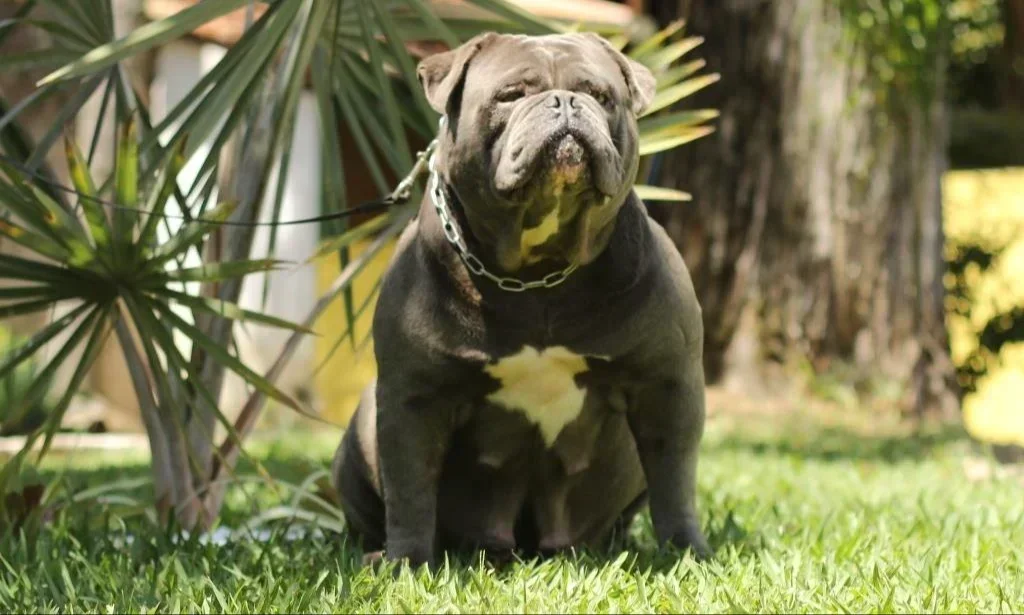
BRIEF HISTORICAL SUMMARY: This breed comes from the province of Cordoba, in the Mediterranean region of the Argentine Republic. Antonio Nores Martinez, an eminent and active breeder born in Cordoba in 1907 who died in 1956, started from the “Old Fighting Dog of Cordoba”, the product of the crossbreeding then being done between Bulldogs and Bull Terriers. He chose for breeding all-white dogs, without an undershot bite, with heavy heads and long muzzles. After intense, careful selection and study of character over several generations, he achieved his goal by forming several families, always starting from that “Old Fighting Dog of Cordoba”, which he initially crossed with the English Bulldog, Great Dane, Pyrenean Mastiff, Bull Terrier, Boxer, Pointer, Dogue de Bordeaux and Irish Wolfhound. By 1947 the breed was already created and genetically and phenotypically stable; that same year he presented the breed standard at the Hunters' Club of the City of Buenos Aires. Its strength, tenacity, sense of smell and courage are unmatched among pack dogs for hunting wild boar, peccaries, pumas and other predators of farms and livestock that inhabit vast and varied regions of Argentina. This is the traditional activity for which Antonio Nores created the breed. In 1964 it was recognized as a breed by the Argentine Cynological Federation and the Argentine Rural Society, which opened its “Studbook” and began registrations. Later, in 1973, the breed was accepted by the FCI (International Canine Federation).
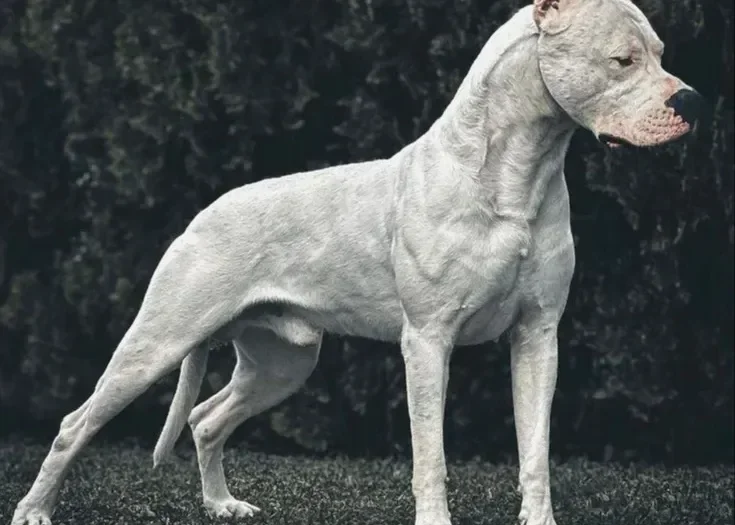
GENERAL APPEARANCE : It is an athletic, mesomorphic dog of normal type and harmonious proportions. With powerful musculature, it is agile; its outward appearance conveys power, energy and strength, contrasting with its friendly, gentle expression. Entirely white, it may have only one marking on the skull.
IMPORTANT PROPORTIONS
• Mesocephalic; the muzzle should be the same length as the skull.
• The height at the withers should be slightly greater than the height at the croup.
• The depth of the chest should be at least 50% of the height at the withers.
• The length of the body should exceed the height at the withers by up to 10% (no more).
BEHAVIOR / TEMPERAMENT : It should be silent, never barking on the trail, with a good nose, a keen tracker, agile, strong, hardy and above all brave. It must never be aggressive toward people, a trait that will be observed several times. It should give itself to its owner unconditionally and without reservation.
HEAD : Mesocephalic type, strong and powerful in appearance. Its craniofacial axes converge.
Skull: Massive, convex from front to back and from side to side because of the relief of the chewing and neck muscles. Occiput: Its protrusion is not visible because the powerful neck muscles hide it completely. Stop: Defined, should be neither deep nor form right angles.
FACIAL REGION: Equal in length to the cranial region, that is, the line joining the two orbital processes of the frontal bone is equidistant from the occiput and from the alveolar edge of the upper jaw.
Nose: Strongly pigmented black, with very wide nostrils.
Muzzle: The same length as the skull, with a concave topline.
Lips: Tight, with free edges, pigmented black, never pendulous.
Jaws / Teeth: consisting of correctly positioned, well-developed and strong jaws, neither undershot nor overshot, with healthy, large, normally placed teeth. Full dentition is recommended. The bite is scissor (that is, the back of the upper incisors touches the front of the lower incisors, overlapping them); a level bite is accepted (that is, the upper incisors meet
tip to tip with the lower incisors).
Cheeks: Broad, well marked, covered by strong skin without folds. Cheek muscles well developed.
Eyes: Medium-sized, almond-shaped, dark or hazel, preferably with black-pigmented eyelids. Their position is subfrontal, well apart, with a lively, intelligent look, but with a marked hardness at the same time.
Ears: Set high and to the side, well apart because of the width of the skull. For working purposes, they should be cropped and erect, triangular in shape, and no longer than 50% of the front edge of the natural ear. Uncropped, they are medium-length, broad, thick, flat and rounded at the tip. Smooth-coated, slightly shorter than on the rest of the body, where small, unpenalized spots may appear. Carried naturally hanging, covering the back of the cheeks. When alert, they can be semi-erect.
NECK : Thick, arched, with very thick skin at the throat forming wrinkles, with soft folds but without forming a dewlap. The elasticity of the neck skin is due to very loose connective tissue.
BODY : Rectangular. The length of the body (measured from the point of the shoulder to the point of the ischium) may exceed its height at the withers by only up to 10%, no more.
Topline: Higher at the withers and sloping gently down to the croup. Adult dogs show a median groove along the spine, formed by the relief of the spinal muscles. Viewed in profile, it should not appear sagging.
Withers: Strong, well marked and high.
Shoulder blade: Very strong, with prominent musculature.
Loin: Short, broad, with great musculature.
Croup: Broad and strong, with a medium slope.
Chest: Broad and deep. Viewed from the front and in profile, the sternum should be below the line of the elbows, giving maximum breathing capacity. Long chest, with moderately sprung ribs.
Underline and belly: Slightly tucked up from the lower line of the chest, never greyhound-like; strong and with good muscle tone.
TAIL : Long, not reaching below the hocks; thick, set at medium height. At rest, it hangs naturally; when alert or moving, it is raised in an arc with a wide upward curve.
FOREQUARTERS
General appearance: straight, well placed, with short, tight toes.
Shoulders: shoulder blades sloping, with prominent musculature, without exaggeration.
Upper arms: humerus the same length as the shoulder blade, with good slope.
Elbows: sturdy, covered by slightly thicker, elastic skin, without folds or wrinkles. Naturally placed against the rib wall.
Forearms: the same length as the upper arms and perpendicular to the ground; with strong, straight bones and good muscle development.
Wrist joints: long and in line with the forearms; free of bony protrusions and roughness.
Pasterns: slightly flat, with good bone; viewed in profile, with a slight slope, but never weak.
Feet: with short, tight toes. With strong, thick, tough pads, preferably black-pigmented.
HINDQUARTERS
General appearance: muscular, with short rear pasterns and tight toes, without dewclaws; with medium angulation.
Thighs: give the whole its strength. Strong, with marked visibility and muscle development.
Stifles: with good slope.
Lower thighs: slightly shorter than the thighs; strong and muscular.
Hocks: the tarsus and metatarsus are short, strong and firm, ensuring the drive of the hind leg. Sturdy tarsus, with a clear point of hock. Rear pasterns sturdy, almost cylindrical and upright, without dewclaws.
Feet: similar to the front feet, although slightly smaller and longer, with the same characteristics.
GAIT / MOVEMENT : agile and firm, with marked changes when it shows interest in something, at which point it stands tall with quick reflexes, typical of the breed. Measured walk. Broad trot, with good front suspension and powerful rear drive. At the gallop it shows all its energy and develops all its power. Its movement is agile and sure at the walk, trot or gallop. It should be harmonious and balanced, showing a solid body construction. Pacing (moving both legs on the same side at the same time) is not accepted and is considered a serious fault.
SKIN : elastic, thick but supple. Attached to the body by semi-loose, elastic subcutaneous tissue, without forming wrinkles, except in the throat area, where the subcutaneous tissue is looser. Dogs with black-pigmented lips and eyelids are preferred. Black-pigmented skin is not penalized.
Hair: uniform, short, smooth, about 1.5 cm to 2 cm long. Its density and thickness vary with the climate.
COLOR : entirely white. Only one black or dark marking on the skull is allowed. It may also be on one of the ears or around one of the eyes. The size of the marking should be in proportion, not exceeding 10% of the size of the head. Between two dogs of equal quality, the judge should always choose the whiter one.
SIZE / WEIGHT
Height at the withers: Males: 60 to 68 cm.
Females: 60 to 65 cm.
Ideal height: Males: 64 to 65 cm.
Females: 62 to 64 cm.
Approximate weight :
Males: 40 to 45 kg.
Females: 40 to 43 kg.
FAULTS : any departure from the terms of this standard should be considered a fault and penalized in exact proportion to its severity and its effects on the dog's health and welfare and on its ability to perform its traditional work.
• Lack of bone and muscle development (weakness).
• Partially pigmented nose in adult dogs.
• Small, weak or diseased teeth.
• Entropion or ectropion of the eyelids.
• Eyes that look round because of the shape of the head; prominent, light or yellow eyes.
• Barrel chest.
• Keel chest; flat ribs.
• Lack of chest depth, not reaching the line of the elbows.
• Lack of angulation in any of the legs.
• Croup higher than the withers.
• Pacing gait.
• Males and females whose weight does not match that set out in this standard and is out of proportion to their height.
DISQUALIFYING FAULTS
• Aggressiveness or excessive shyness.
• Any dog clearly showing physical or behavioral abnormalities shall be disqualified.
• Overshot or undershot jaw.
• Deafness.
• Lack of breed type.
• Long coat.
• Total lack of nose pigmentation in dogs over two years old.
• Brown nose.
• Pendulous lip.
• Spots on the body coat.
• More than one marking on the head.
• Size below or above the limits set.
• Eyes of different colors or blue eyes.
• Lack of sexual dimorphism.
NOTES :
• Males should have two apparently normal testicles fully descended into the scrotum.
• Only functionally and clinically healthy dogs with breed-typical conformation should be used for breeding.