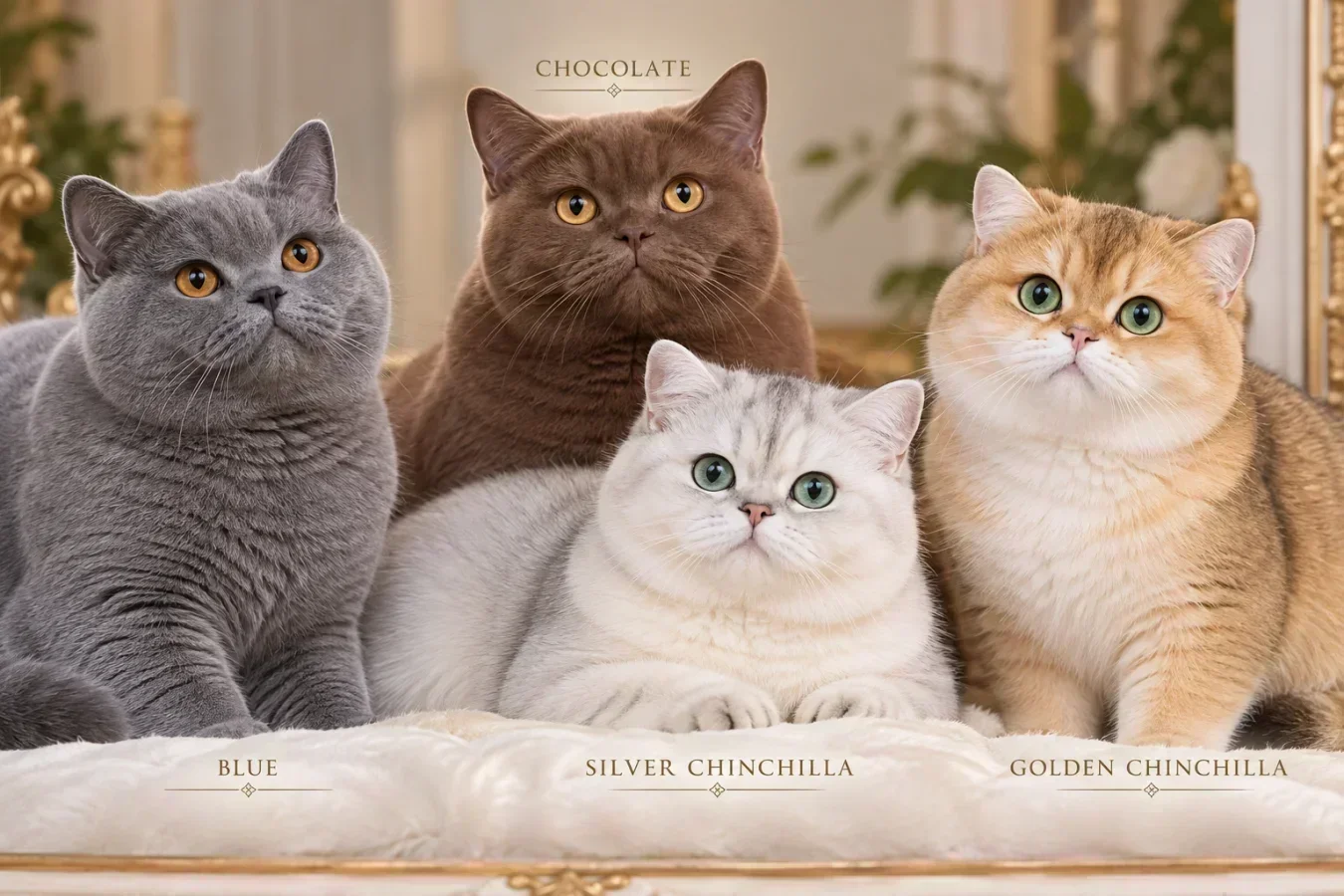
These colors (except white) are the basic colors on which other patterns and effects act.
In the Black (B) series, the locus stands for “black”, since the dominant gene at the locus is expressed as a black coat color. The genes at the B locus influence the expression of eumelanin only.
Two mutations of the B gene have been identified: b (brown or chocolate) and bl (light brown or cinnamon).
The order of dominance: B (Black) > b (Chocolate) = bl (Cinnamon)
SOLID COLORS (Black)
Black: In solid black cats, the nose and paw pads will also be black. Some black cats, especially longhaired ones, may have a reddish tinge in the sun, or a brownish tinge from sun exposure.
SOLID COLORS (Chocolate)
Chocolate: A brown cat, which may be light brown or dark brown. The nose and paw pads will also be chocolate.
SOLID COLORS (Cinnamon)
Cinnamon: A reddish brown. Nose and paw pads will be the same color or pinker.
A chocolate cat on the left, and a (lighter) cinnamon cat on the right.SOLID COLORS (Orange)
Orange: (Orange or Yellow) Ranges from a dark orange to a yellow. All orange cats have stripes.
SOLID COLORS (Cream)
Cream: Pale yellow or beige, sometimes with a slight pinkish tone. The nose and paw pads are pink. Like red cats, cream cats cannot be solid, and any that look solid simply have very low-contrast markings. SOLID COLORS (Cream)
SOLID COLORS (Blue)
Blue: A cat ranging from light bluish gray to dark slate. The nose and paw pads are also blue, but may be darker than the coat.
SOLID COLORS (Lilac)
Lilac: A gray cat with a pinkish tone. The shade may vary. The nose and paw pads are lilac or pinkish lilac and may be darker than the coat.
SOLID COLORS (Fawn)
Fawn: A lighter lilac. The nose and paw pads are pink.
SOLID COLORS (White)
White: All-white cats have pink noses and paw pads. White cats also have a higher incidence of heterochromia.
SOLID COLORS (Tortie)
Tortoiseshells: (Tortie) the vast majority of cats with this color are female. These cats have “red” (pheomelanin) and “black” (eumelanin) patches. They may be diluted to chocolate and/or blue.
Agouti (A_)
Agouti (A) is a gene that affects the distribution of pigments in a cat's hair (eumelanin and pheomelanin on the same hair), so that each hair shows alternating bands of dark and light pigmentation.
The recessive allele (non-agouti “aa”) makes the cat's hair a solid color from tip to root. (A > a)
The dominant allele (A) controls the alternating pigmentation along the hair (ticking or tabby banding).
Tabby Patterns
Tabby cats have a coat pattern that may include stripes, swirls, spots or rings. The tabby pattern is determined by the agouti gene, which controls the distribution of pigment in each of the cat's hairs.
Both longhaired and shorthaired cats can show these patterns.
All tabby cats, whatever their tabby pattern, will have an “M” on the forehead.
You will also find tabby cats in a wide range of coat colors, including cream, lilac, gray, blue, red, chocolate, golden, cinnamon, black, etc.
There are 4 distinct tabby patterns: Classic Tabby, Mackerel Tabby, Spotted Tabby and Ticked Tabby, plus the variations (Broken Mackerel Tabby and No-striped Tabby).
1- Classic Tabby
This pattern is characterized by wide bands of dark stripes against a lighter background. On the forehead between the eyes there is a characteristic “M”; on each side of the cat you will see a concentric swirl called a “bull's-eye”; on the back between the shoulders there is a lighter area known as the “butterfly”; and 3 dark stripes run along the back. In addition, many Classic Tabby cats will have spotted bellies and striped bands around the neck and on the legs. These striped markings are known as necklaces and bracelets.
2- Mackerel Tabby
The tabby stripes tend to be narrower and run vertically down the cat's body.
3- Broken Mackerel Tabby
Produces stripes on the head, legs, tail and body; the stripes look broken, a mix between Mackerel and Spotted.4- Spotted Tabby
The spotted pattern is seen most often in the Bengal breed. This pattern is produced by a color modifier that breaks up the stripes and creates the appearance of round spots. In some cases, but not all, three distinct coat colors can be seen: a dark ring around a lighter “spot”, both set on an even lighter base color.
5- Ticked Tabby
Unlike the previous tabby patterns, Ticked tabbies may show few visible stripes on their bodies. They may have stripes on the head, legs and tail, but not on the body. Instead, the banding occurs on each hair of the cat's coat, as determined by the agouti gene.
6- No-striped Tabby
They have no stripes on the coat. In this type, the eumelanin color is restricted to the tips of the hair, giving a shaded look; the mutated genes responsible for this are the ‘Wide-band’ (Wb) genes. We will have a separate topic just about shading.
Shading
There are three types of shading: Chinchilla (Tipped), Shaded (Shadow) and Smoke, each differing in how far the shading extends along each hair.
Chinchilla: Only the tip of the outer coat hair is colored, which gives the coat a sparkle. The undercoat does not get this marking.
Shaded (Shadow): 1/4 of the tip of the hair is shaded.
Smoke: Half of the hair is shaded. When a Smoke cat is standing still, the coat pattern may look solid, but when the cat moves or you stroke it, you can see the lighter undercoat.
Types of Chinchilla - Silver Chinchilla
The Silver Chinchilla coloring is enchanting: a white background shows silvery highlights, and contrary to what many think, these are not “white” cats; they are actually golden! The lightening of the golden hair is caused by a dominant gene known as the Melanin Inhibitor (I_), whose presence reduces pigmentation. The Silver Inhibitor appears to reduce or eliminate the production of pheomelanin in the cat's hair, giving it a beautiful, rare color!
Types of Chinchilla - Golden Chinchilla
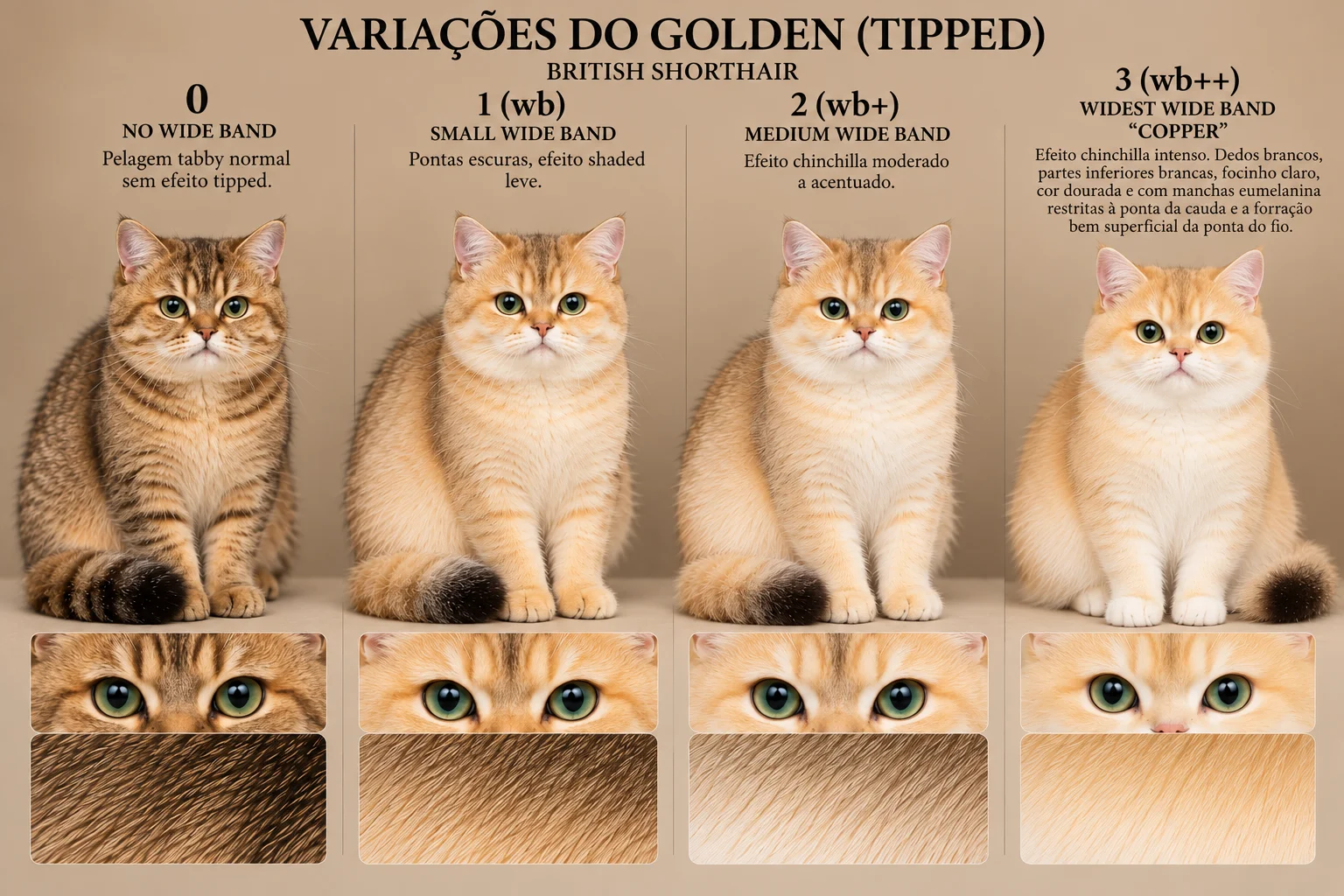
A very sought-after color, especially because it makes the cat look like a wild animal, beautiful and exotic. It is one of the rarest colors in the British Shorthair / Longhair breed.
In golden cats, the dominant Melanin Inhibitor (I) is absent: Golden (ii) = non-silver.
All Tipped cats may come from recessive Ticked, Shaded, Chinchilla & Tipped “Copper” lines.
The term “copper” was adopted to describe Golden Shell cats with white toes, white underparts, a light muzzle, golden color, and eumelanin markings restricted to the tip of the tail and a very shallow tipping on the ends of the hair.