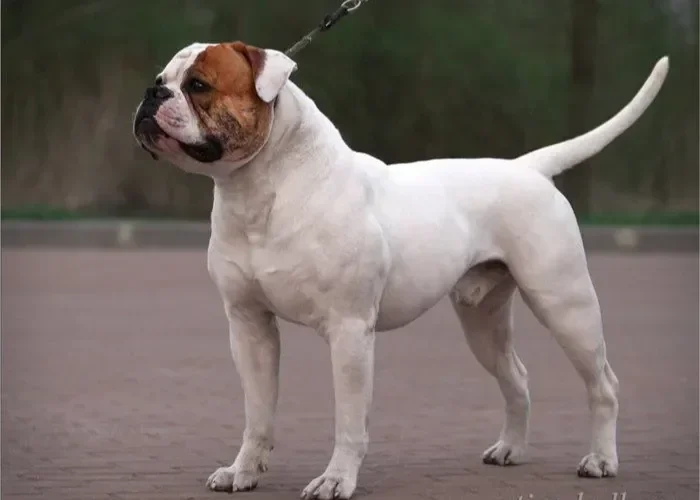
Introduction: Historically, the American Bulldog was developed mainly as a working (utility) breed on farms. On the rural properties of the southern and southeastern United States, where the breed originated, they were used to work cattle and wild hogs. It was also an integral part of the family, also helping protect people and property. The essential characteristics of the American Bulldog are those that make it able to catch both cattle and wild hogs, and to serve as a personal and property guardian. These tasks require a powerful, agile and dependable dog, with a large head and powerful jaws. The American Bulldog is brave enough to face a fearsome bull or an intruder, aggressive enough to fight a bear or a wild hog, yet gentle enough to be a companion dog and loving with the family.
General Appearance: The American Bulldog is a well-balanced, short-coated, athletic and muscular animal. It shows great strength, endurance and agility, powerfully built yet active. Males are characteristically larger, heavier-boned and more muscular than females.
Bone structure: medium to heavy, able to support a large dog.
Temperament: American Bulldogs should be alert, outgoing and confident, with no sign of fear or shyness. Keeping a distance and being reserved with strangers is acceptable. Showing some aggression toward other dogs is also not considered a fault.
Faults: Aggressiveness or excessive shyness
Size: Standard Type: Standard-type males should preferably measure between 55 and 68 cm at the withers and weigh between 34 and 43 kilos. Females: 53 to 63 cm, 27 to 38 kilos.
Bully Type: Bully-type males should preferably measure between 55 and 68 cm at the withers and weigh between 40 and 55 kilos. Females: 53 to 66 cm, 33 to 47 kilos.
Note: The overall proportions of the dog are very important when assessing weight.
Head: The head should be large and broad, flat on top, square in appearance, with a very well-defined stop (where the muzzle meets the skull). It should be of medium length, with well-pronounced facial muscles.
Standard Type: A compact or wedge shape is ideal.
Bully Type: A large, rounded shape is ideal.
Muzzle: The muzzle should be broad, with well-opened nostrils. The lips should be full and pigmented; some pink pigmentation is allowed. The chin is well defined and should not overlap or cover the upper lips.
Standard Type: The muzzle should measure 5 to 10 cm. Proportionally, it should be between 35% and 45% of the total length of the head.
Bully Type: The muzzle should measure between 5 and 7.5 cm. Proportionally, it should be between 25% and 35% of the total length of the head.
Faults: Pendulous lips. Narrow muzzle. Full black mask.
Remark: the muzzle should be in proportion to the size and type of the head.
Nose: The preferred color is black. Red, brown, gray or pale are also accepted.
Cosmetic faults: Pink or unpigmented nose.
Dentition: The teeth should be medium to large and not visible when the mouth is closed. The lips are moderately thick and preferably pigmented; some unpigmented areas are allowed.
Standard Type: a slight undershot bite (reverse scissor) is preferred. An undershot bite of up to 0.6 cm is acceptable.
Bully Type: undershot bite between 0.6 and 1.3 cm, depending on the size of the dog and the shape of the skull. A margin of error of plus or minus 0.3 cm is acceptable.
Faults: small teeth or crooked incisors.
Disqualification: excessive undershot bite, overshot bite, or wry mouth (twisted jaw).
Bully Type: Disqualification: level or scissor bite.
Remark: the American Bulldog is a working breed, and no penalty should be imposed for broken or missing teeth.
Eyes: They should be round or almond-shaped, medium-sized, set apart. Color: Preferably brown. Blue, gray and green are also common. The third eyelid should not be visible. Pigmented eyelids are preferred.
Cosmetic faults: Eyes of different colors. Pink eyelids. Excessively visible third eyelid.
Serious fault: Wall eyes, crossed and/or asymmetrical eyes.
Ears: The ears should be set high and be small to medium in size, carried close to the head. They may be drop, half-prick or rose.
Faults: Cropped ears. Very long ears.
Neck: Slightly arched, very muscular and of moderate length, tapering slightly from the shoulders toward the head.
Bully Type: The neck should be almost the same size as the head
Faults: Neck too short and thick; thin or weak neck.
Body: Broad, with a deep chest; it should be compact and well balanced. The chest should not be narrow or excessively wide, nor should the shoulders be pushed out or in. The back should be broad and moderately short, showing great strength.
Chest: The chest should be deep (with ample room for the heart and lungs) and moderately wide, giving an appearance of power and athletic ability. In general, the front should be straight and well balanced. The chest should not be narrow or excessively wide.
Ribs: well sprung from the spine, giving the body enough depth to reach at least the elbows or, in adult dogs, a little lower;
Topline: slopes gently (downward) from well-marked withers to a broad, muscular back;
Faults: The back should not be narrow, excessively long or swayed.
Loin: short and broad, and slightly arched, joining a moderately sloping croup;
Flank: moderately tucked up and firm;
Note: The degree of the fault will depend on how it affects the dog's working ability and movement.
Hindquarters: Broad, well muscled, with well-set muscles showing speed and strength, but not as broad as at the shoulders. There should be neither too little nor too much angulation of the hind legs.
Serious faults: Narrow or weak hindquarters; excessively angulated or straight stifles; weak pasterns; cow hocks or open hocks; scissor-legged; bowed legs.
Lower thighs: The legs should be strong, with moderate to heavy bone. The front legs should not be set too close together or too far apart. The pasterns should be strong, firm and straight. The hind legs should be moderately angulated and parallel to each other.
Faults: straight or loaded shoulders; elbows turned out or tied in under the chest; bowed front legs; weak pasterns; feet turned in or out.
Serious faults: Excessively bowed front legs; straight or excessively angulated stifles; cow hocks or open hocks; weak hocks; bowed legs.
Feet: The feet should be round and medium-sized; the toes should be arched, close together and firm.
Faults: Splayed feet or crooked nails.
Note: The seriousness of this fault should be in proportion to the number of faults in the dog's feet.
Tail: Strong at the root, tapering toward the hock, in the relaxed position. The tail is carried raised when the dog is excited or walking. A raised tail is preferred, but any tail carriage, from raised when the dog is excited to relaxed between the hocks, is acceptable. The tail should not end in a full circle.
Faults: Tail curled over the back; “corkscrew” or crooked tail.
Note: The natural tail is preferred. A docked tail is acceptable but is considered a cosmetic fault.
Movement: At the trot, movement should be “balanced and smooth”, showing great speed, agility and power. Movement is effortless, smooth, powerful and well coordinated, showing good reach and drive. The dog should not move with an excessively wide gait. As speed increases, the feet tend to converge toward the center line of the body to maintain balance. The topline stays firm and level, parallel to the line of movement.
Viewed from any position, the legs turn neither out nor in; the feet do not cross or interfere with each other. Poor movement should be penalized to the extent that it impairs the dog's ability to perform its tasks.
The stride of Bully-type dogs will have less reach and flexibility than that of Standard-type dogs.
Faults: Legs not moving in the same plane; front and hind legs crossing; front or hind legs moving too close together or touching; “paddling” strides; crabbing (moving sideways).
Coat: The coat should be short and smooth, but harsh to the touch.
Disqualification: Long or wavy coat.
Colors: Solid white; any color or any pattern, including: black, red, brown, beige, fawn, chocolate, gray, mahogany, cream, caramel and all brindle variations (white, red, yellow, blue, brown, black or gray).
Faults: Any color without at least 25% white.
Disqualification: Dogs with any amount of merle.
Notes:
Males should have two apparently normal testicles descended into the scrotum.
Any dog showing any sign of physical abnormality, blindness or deafness, unilateral or bilateral, should be disqualified.
Any dog showing signs of behavioral deviation should be disqualified (extremely aggressive or shy dogs). Shyness: A dog should not be overly shy, refusing to stand for examination or cowering in the presence of the judge, being frightened when approached from behind, or being overly startled by unusual, sudden noises. Puppies should not be severely penalized on this point. With maturity and socialization, their confidence should improve. Excessive aggression: A dog that attacks, or tries to attack, the judge or the handler without provocation should be considered excessively aggressive. However, a dog with an aggressive or challenging attitude toward other dogs is considered acceptable.
Dogs with long, curly coats or an overshot bite are disqualified; in the Bully type, a level or scissor bite.
Cosmetic faults: Cosmetic faults are those of minor severity. A fault not specified as “cosmetic” must necessarily relate to the dog's structure, since structure is related to the dog's working ability.
Structural faults: These faults are associated with the dog's structure itself or its movement. They should be weighed according to their severity and their effect on the dog's working ability.
At a show or any other type of evaluation, the dog should always be penalized in direct proportion to the severity of the fault. Any fault that is extreme should be considered a serious fault and penalized accordingly.
Note: Factors that are disqualifying or penalized at beauty and conformation shows should in no way be considered grounds for disqualification in “working trials”, nor take away any merit a dog may have earned in “working trials”. A conformation show is just that, conformation, and is in no way to be considered a judgment of a dog's working abilities. There is, however, no excuse for dogs with unsound temperament, and such dogs should, as far as possible, be disqualified from both working and conformation events.
It is preferred that females in season do not take part in shows.
Conformation Judging Points
Body
Shoulders: 10 Points
Chest: 10 Points
Hindquarters: 10 Points
Legs: 05 Points
Neck: 05 Points
Feet: 05 Points
Tail: 05 Points
Coat: 05 Points
Subtotal: 60 Points
Temperament: 10 Points
Proportions: 05 Points
Movement: 05 Points
Subtotal: 20 Points
Head
Size and Shape: 10 Points
Muzzle: 05 Points
Bite/Teeth: 05 Points
Subtotal: 20 Points
Grand Total: 100 Points