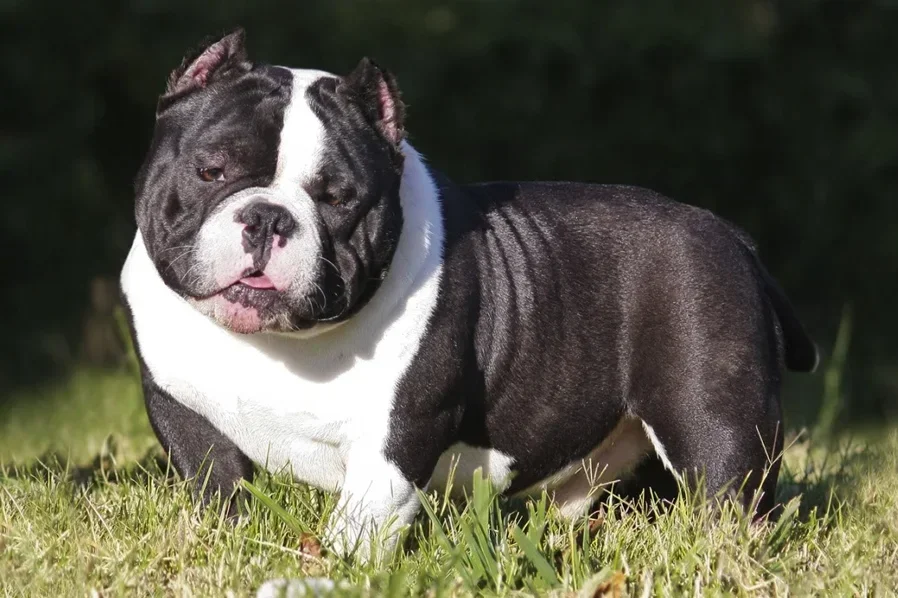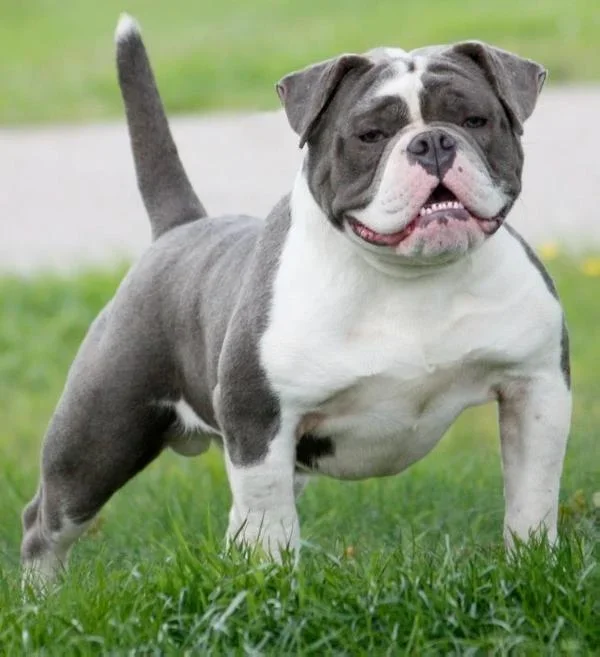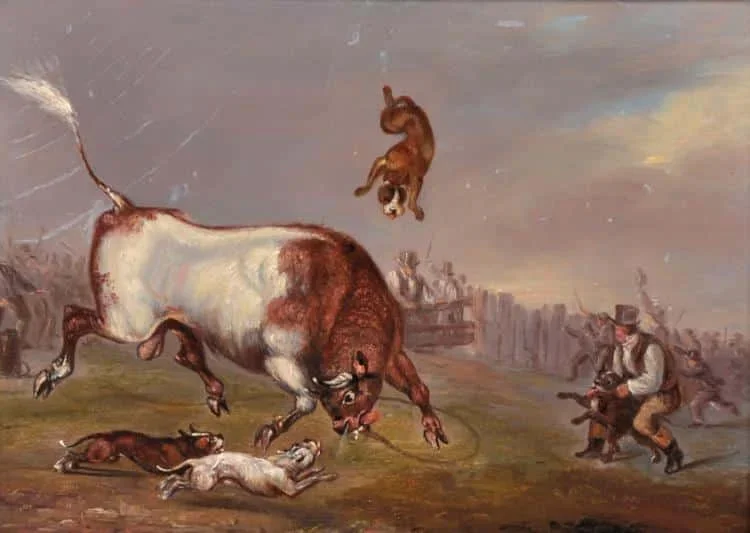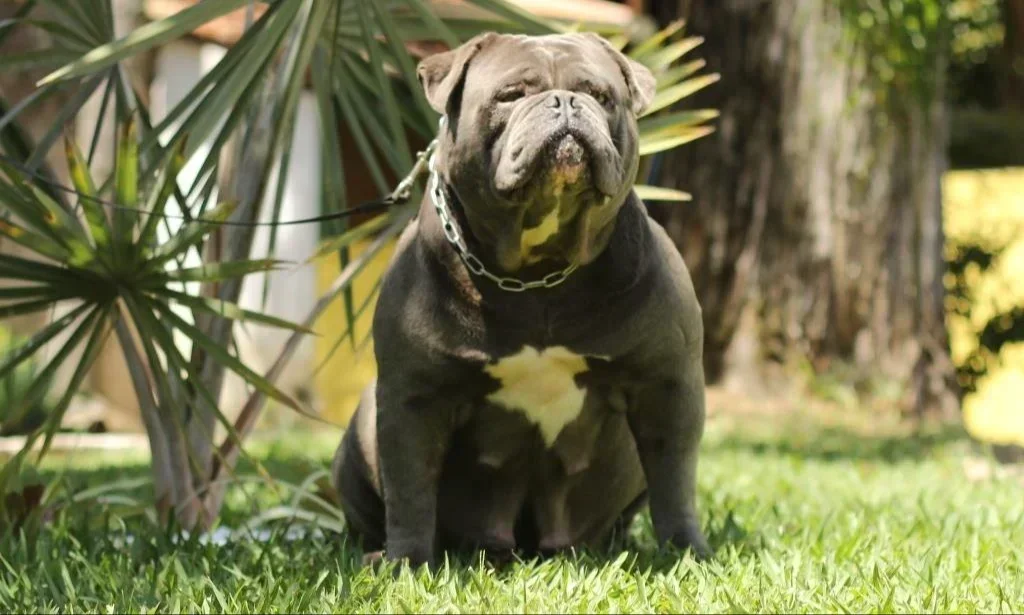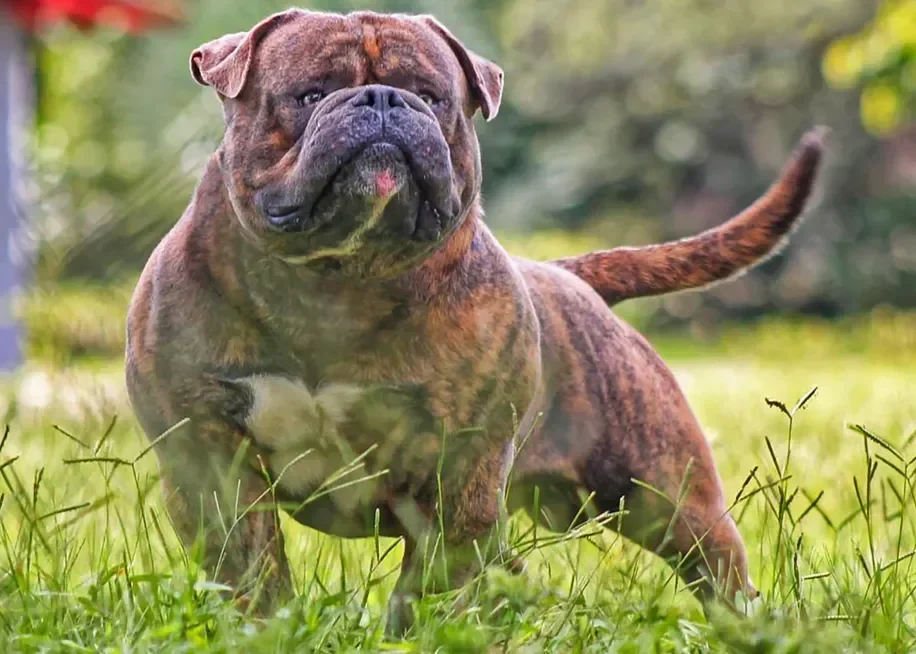
The modern OEB is a re-creation of the Bulldogge that existed in the 17th and 18th centuries. The project was led by David Leavitt in the 1970s, with support from Ohio State University. Leavitt focused on creating a breed with the phenotype, agility and health of that old Bulldogge, but with a less aggressive temperament geared toward COMPANIONSHIP. The result was a dog free of many of the ailments that affect modern breeds. Among other traits, the OEB breathes freely and is capable of natural mating and natural whelping.
The genuine Olde English Bulldogge has been gaining immense popularity around the world, especially in Europe, where the dog fancy is very traditional and advanced. There are pedigree records listing more than a hundred ancestors.
OFFICIAL BREED STANDARD
General description: The typical Olde English Bulldogge is a loyal, courageous, medium-sized dog with a large, powerful head, a solid body and well-developed musculature.
Olde English Bulldogges are athletic and fundamentally very healthy. Males breathe freely and females whelp on their own.
The Olde English Bulldogge is free of any breathing problems and can take part in outdoor activities without difficulty, except in very hot or extremely cold weather.
The temperament is very balanced and reliable, making them loyal companions able to protect and be part of the family.
Olde English Bulldogges are eager to please their owner and are very trainable.
Life expectancy is 10 to 14 years.
Head: Large and high, moderately furrowed between the eyes (moderate wrinkles).
The circumference of the head should be equal to or greater than the dog's height at the withers. A narrow head, or one that is small in relation to the body, is a fault.
Ears: Rose ears set well to the side of the head are preferred. Drop ears are accepted if small, not HOUND-type. Pointed ears held high on the head are a serious fault.
Muzzle: Broad, thick and short, with moderate wrinkles. The bite is markedly undershot. The lower canines should not show. A long muzzle (more than 7.5 cm), a scissor bite or a level bite are disqualifying faults. The muzzle should not be less than 3.8 cm. A wry jaw is a disqualifying fault.
Eyes: Set well apart and of moderate size. Any color is accepted. However, mismatched eyes, such as one dark and the other blue or light, should be avoided. Crooked or bulging eyes are a serious fault. Lack of pigmentation around the eyes is undesirable.
Crossed eyes or eyes of asymmetrical shape are disqualifying faults.
Nose: Broad, with nostrils showing no sign of breathing difficulty. The nose should point upward between the eyes. From the stop to the end of the nose there should be at least 2.5 to 3.8 centimeters. The nose leather should be a solid color. Gaps in its pigmentation are a serious fault. A completely unpigmented nose is a disqualifying fault.
Neck: Of moderate length, with well-developed musculature flowing into the shoulders. It should not look as if it ends at the shoulders.
Chest: The ribs should be well sprung and the chest broad and deep.
The chest should reach at least to the level of the elbows. A narrow or hollow chest should be considered a serious fault.
Back: Males should look square and balanced; females should look similar with slightly more body length. A short back, with a slight rise from the shoulders and a slight slope down to the rump, is preferred. A level back is accepted, as long as the tail does not come off the top of the back.
Shoulders: The shoulders should be sloping, with significant angulation allowing good movement. Straight shoulders are a fault.
Limbs: The front legs should be straight and set well apart, neither bowed nor turned in. Strong boning, with the elbows relatively close to the body. Lack of bone or mass is highly undesirable. Loose or tucked elbows are disqualifying faults. East-west front feet are serious faults. The hindquarters should show good stifle angulation allowing good movement. They should be well muscled. Straight hindquarters are a serious fault. Cow hocks are disqualifying faults.
Movement: Dogs should have a balanced trot, driven from the rear with good reach, allowing the dog to move with a powerful look. Dogs should single-track. Pacing or crabbing is a serious fault.
Feet: Round and compact, both front and rear, and the pasterns should be strong. Weak pasterns or splayed feet are disqualifying faults.
Height: Males 45.8 to 50.8 cm at the withers / Females 43.2 to 48.2 cm at the withers.
Weight: Between 29.5 and 38.5 kg for males / Between 22.5 and 31.5 kg for females.
Although height and weight above the standard are not recommended, there will be no penalty if the dog is well proportioned, correct and balanced.
Colors: All colors are accepted with no preference among them. The coat is short. A wavy or long coat is a disqualifying fault.
There should be no signs of long hair on the legs or neck area, which is also a disqualifying fault.
Tail: A curved tail that naturally reaches the hock is preferred; short screw tails or docked tails are acceptable. The tail should be carried low and not over the dog's back.
Temperament: Should be willing and happy. Natural guarding of the home may occur. Unprovoked aggression toward people is a disqualifying fault.
Revised on July 4, 2006.
Portuguese translation: Miguel Brugnoli