“PURE” BREED
Looking at the countless discussions involving the concept of “breed purity” in the dog fancy, it becomes clear that dog breeds are often treated as if they were natural taxonomic categories, equivalent to those used to classify species and establish evolutionary relationships.
However, dog breed and species are distinct concepts.
All breeds of domestic dog belong to the same species, Canis lupus familiaris. Breeds are not biologically isolated species, nor are they necessarily populations that arose and remained genetically segregated for long periods of time.
For this reason, the expression “pure by origin” must be examined with caution. For a population to be considered genetically isolated since its origin, it would be necessary to demonstrate a history of prolonged reproductive segregation and no outside genetic contributions. For the vast majority of modern dog breeds, that condition cannot be demonstrated.
What we actually find are dog populations subjected to successive processes of artificial selection, in which certain individuals were chosen and bred preferentially because of morphological, functional and behavioral characteristics.
Over the generations, this selection can produce a highly uniform population, with striking and relatively predictable phenotypic characteristics. So, instead of thinking of “purity of origin” as the absolute absence of genetic mixing, it is more accurate to understand many modern breeds as populations genetically selected and stabilized over the generations.
What is a dog breed?
In the context of the dog fancy, a breed can be understood as a population of dogs of the same species that shows a relatively stable and recognizable set of morphological, functional and behavioral characteristics, passed on by heredity and maintained by selection over the generations.
The so-called Breed Standard sets out which characteristics are considered typical of that population: body proportions, bone structure, head, coat, movement, functional characteristics and, where applicable, behavioral aspects.
Thus, the concept of breed is directly related to three fundamental elements:
- Heredity: the characteristics must be genetically transmitted;
- Selection: certain phenotypes are preferentially used in breeding;
- Stabilization: after successive generations, certain characteristics become predictable enough to characterize that population.
In this context, a breed does not need to have arisen from a “pure” population since its origin. It can be the result of crosses between different populations, followed by selection and genetic stabilization.
It is precisely this process that lies behind the development of countless dog breeds recognized today.
DEVELOPMENT OF A BREED: CROSSING, SELECTION AND STABILIZATION
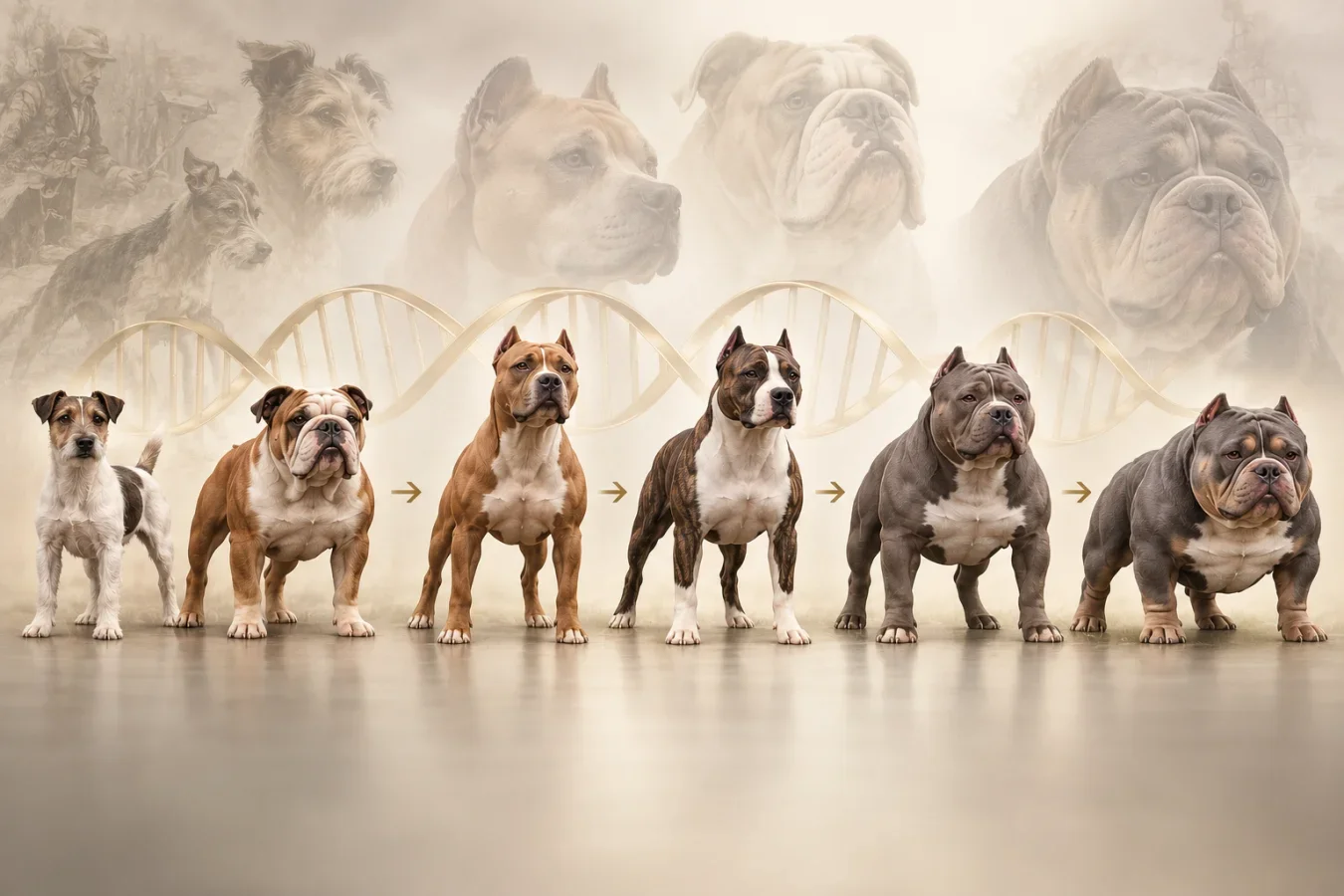
To better understand the difference between “purity of origin” and “breed purity”, we can use as an example the historical development of the Bull and Terrier group of dogs.
At a certain point in history, there were populations of Terrier -type dogs and populations of Bulldog-type dogs. These dogs had distinct functional characteristics.
Terriers were selected mainly for attributes such as agility, endurance and working ability. Bulldogs, in turn, had greater physical power, a sturdy body structure and functional characteristics specific to their historical use.
By crossing these populations, breeders began to seek a specific combination of characteristics:
the agility and tenacity of Terriers + the strength and body structure of Bulldogs.
This was not simply a matter of “mixing two breeds” to produce dogs without identity. The process involved directed selection.
The individuals that best showed the desired characteristics were selected for breeding. Their offspring were evaluated again, and those that best matched the functional goal were used in the following generations.
As this process continues, an initially heterogeneous population can acquire increasingly uniform characteristics.
This is a fundamental principle in the development of many breeds:
crossing → selection → directed breeding → stabilization of characteristics → definition of a breed type.
Therefore, the fact that a population originated from crosses does not prevent it from later becoming a genetically and phenotypically very consistent breed.
FROM FUNCTIONAL TYPE TO BREED STANDARD
The development of different dog populations also shows that the goal of selection can change over history.
While certain populations were originally selected mainly for their functionality, others were later directed toward specific morphological and behavioral characteristics.
In the case of the Bull and Terrier group, historical selection was initially closely tied to functionality.
With the social and legal changes that came later, the purpose of breeding also changed. Selection progressively came to value characteristics such as conformation, body structure, movement and temperament, contributing to the differentiation of new populations and, later, of distinct breeds.
The important point here is not to claim that one breed simply “turned into” another, but to understand that dog populations can share ancestors, show genetic overlap and still become distinct through different selection processes.
This phenomenon is common in the dog fancy.
THE CASE OF THE AMERICAN BULLY
The development of the American Bully itself is a particularly interesting example for discussing the concept of breed formation.
The population that gave rise to the American Bully was built from dogs of the Pit Bull/AmStaff group and other influences selected by breeders, seeking specific characteristics of body conformation, structure, temperament and aptitude for companionship.
The result was not simply a reproduction of the dogs from which it came.
There was a process of phenotypic and genealogical selection, in which certain characteristics were valued generation after generation until a type recognizable enough to receive its own identity was established.
That is why having ancestors from different populations does not prevent the American Bully from later being treated as a breed within a given registry system.
And this point is fundamental:
the genetic origin of a breed and the genealogical definition of belonging to that breed are different concepts.
A breed can have its historical origin in different populations and, once established, have its own genealogical system.
WHEN THE TYPE DRIFTS FROM THE STANDARD
The process can also happen in the opposite direction.
An established breed can undergo progressive changes in its phenotype when certain breeders begin to select characteristics that depart significantly from the originally established standard.
When this selection is repeated over several generations, certain characteristics can become predominant in a population.
If that population later comes to show:
- consistently distinct morphology;
- its own selection goals;
- relatively stable phenotypic characteristics;
- breeders focused on that new type;
- breeding among individuals that show the new phenotype;
- and its own breed standard;
the possibility arises of establishing a new, racially defined population.
It was in this context that there emerged the so-called Exotic Bully.
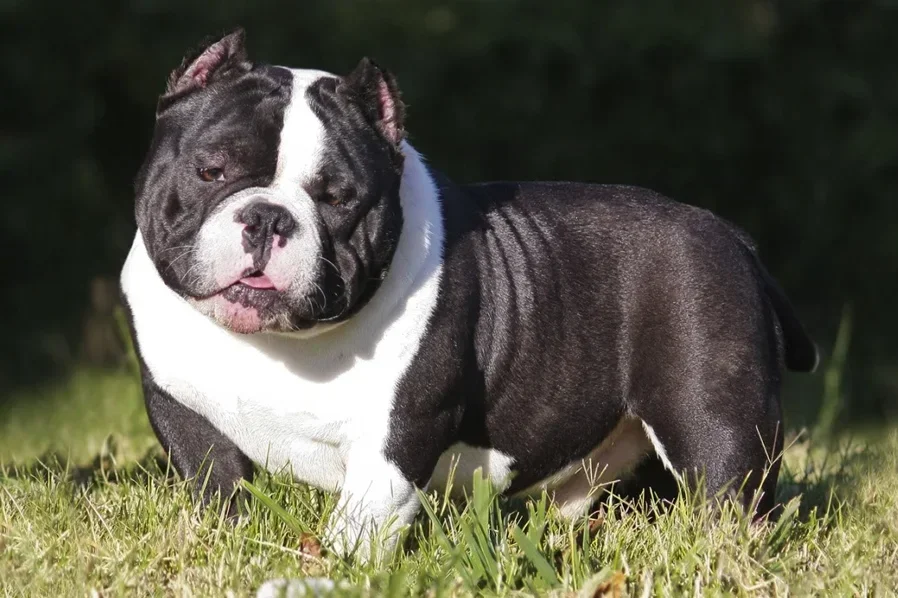
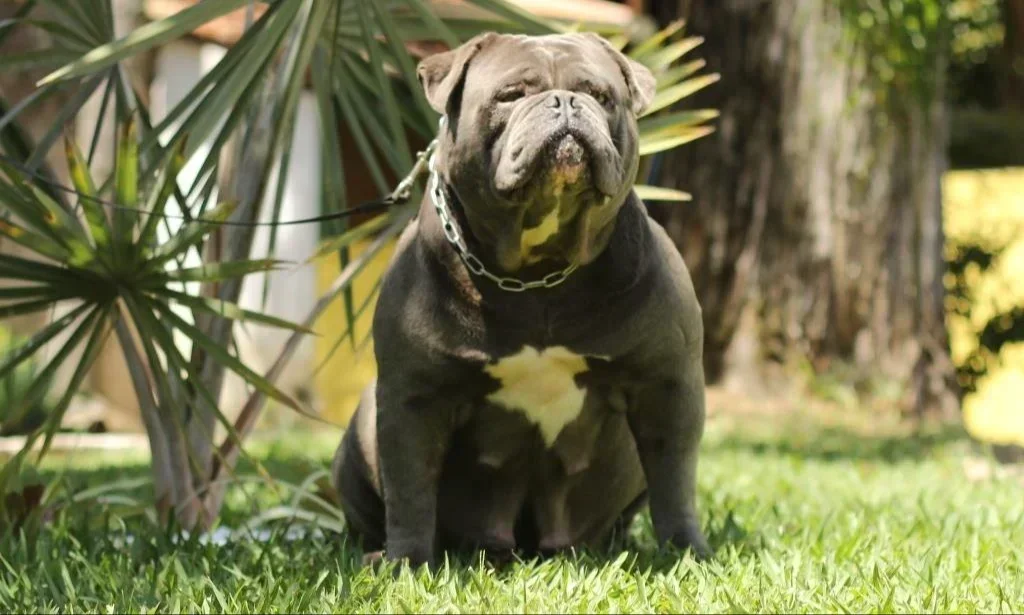
The Exotic represents a population selected for morphological characteristics distinct from those found in the traditional American Bully, with a greater influence of Bulldog-group characteristics and less expression of the Terrier characteristics traditionally associated with the American Bully.
What exists is a process of genetic introduction, selection, directed breeding and subsequent stabilization of characteristics.
This distinction is fundamental.
“MIXING” DOES NOT MEAN THE ABSENCE OF A BREED
There is a frequent contradiction in the debate on breed purity.
When a new breed is formed, its first individuals necessarily have ancestors belonging to other populations.
However, after several generations of selection and stabilization, the descendants can form a population with its own predictable characteristics.
Therefore, saying that a breed has ancestors from other breeds does not mean that all its descendants should be considered mixed indefinitely.
What determines breed membership, within a genealogical system, is the definition of the standard and of the registration rules adopted by the organization that recognizes and regulates that population.
BREED PURITY BY ORIGIN × BREED PURITY BY CROSSBREEDING
It is precisely at this point that IBC draws an important distinction.
We do not use the concept of “pure by origin” because we cannot claim that a given breed has never received a genetic contribution from other populations.
We use the concept of “Pure by Crossbreeding” to establish a genealogical criterion of development.
These percentages represent expected genealogical proportions, and do not mean that the individual genome of a dog can be determined simply by the mathematical formula.
That is why, within IBC's methodology, the term “Pure by Crossbreeding” is a genealogical and regulatory concept, used to indicate that a given population has reached the generation established for breed purity to be acknowledged within that system.
It does not claim that the animal is genetically “100% pure” or that it has no ancestry from the populations used in the breed's development.
THE ROLE OF THE PEDIGREE
The pedigree also needs to be understood in this context.
The pedigree is a genealogical recordthat documents the animal's registered ancestry and its classification within a given registry system.
So, when we say that a certain dog is “pure” within a breed, we are talking about its genealogical and regulatory status, defined by the rules of the organization responsible for registering that breed.
A breed is therefore a construct that is at once biological, historical, genetic and part of the dog fancy.
Genetics explains the origin and transmission of characteristics.
Artificial selection explains their concentration and stabilization.
The breed standard describes the desired phenotype.
And the genealogical system sets the formal criteria for recognizing the individuals that belong to that population.
THE TRUE ROLE OF THE BREEDER
For this reason, when every cross between breeds is regarded as an “attack on the dog fancy”, the problem is not simply the use of individuals from different populations.
The central question is how that selection is carried out.
A responsible program to develop or improve a population should consider:
- genetic health;
- genetic diversity;
- morphological characteristics;
- functionality;
- temperament;
- hereditary diseases;
- reproductive capacity;
- longevity;
- welfare;
- and the stability of the desired characteristics.
The goal should be to build a genetically monitored, phenotypically predictable and functionally healthy population, in which the desired characteristics can be passed on consistently to the following generations.
CONCLUSION
The discussion about “breed purity” must therefore abandon the idea that a dog breed is a biological entity that necessarily arose without any genetic mixing.
Modern breeds are largely the result of artificial selection, historical crosses, relative reproductive isolation and stabilization of characteristics over the generations.
The fact that a breed was developed from other populations does not necessarily diminish its breed identity.
In the same way, recognizing a breed does not mean claiming that it arose in genetic isolation.
The real question is to understand at what point a population stops being merely a set of crosses and becomes a racially defined population, with its own characteristics, directed selection, an established standard and controlled genealogy.
That is the point at which the dog fancy stops discussing mere “mixing” and starts discussing breed formation.
And that is also why IBC uses the concept of “Pure by Crossbreeding”, deliberately distinguishing it from the idea of “Pure by Origin”.
A breed is not defined by the absolute absence of outside ancestry.
A breed is defined by the identity that has been built, selected, stabilized and recognized over the generations.