By Carol Beuchat, PhD
If you breed purebred dogs and care both about the health of the puppies you produce and about the future of the breed, you need to understand why the list of genetic diseases in dogs keeps growing.
- It is not because of environmental toxins.
- It is not because of vaccines.
- It is not because of commercial dog food.
- It is not because of backyard breeders or puppy mills.
- It is not because of better diagnostics and veterinary care.
WHAT IS THE PROBLEM?
Among biologists, veterinarians and genetics researchers, there is no controversy about the cause of the growing list of genetic diseases in dogs.
The genome of every animal harbors numerous mutations that are passed down from generation to generation without causing harmful effects, because they are recessive. Most genetic diseases in dogs are not caused by a new mutation, but by old mutations that arose in some animal hundreds or even thousands of generations ago, or perhaps were inherited from the ancestral wolf itself.
These mutations result in a genetic disease when a dog inherits two copies of the mutation.
The growing burden of genetic disease in purebred dogs is a direct and predictable consequence of breeding practices that increase the expression of deleterious alleles.
WHAT DO THE EXPERTS SAY?
Mellersh, 2012
“Intense selection, high levels of inbreeding, extensive use of a limited number of sires and genetic isolation are hallmarks of modern domestic dog breeds. It is widely acknowledged that part of the collateral damage of these practices is that purebred dogs are at greater risk of suffering from genetically simple inherited diseases than their mixed-breed counterparts.”
Rooney & Sargan, 2009
“The indirect effects of selection for appearance traits include a very significant reduction in genetic diversity, distributed unevenly across the genome, resulting in a higher prevalence of specific diseases within certain breeds. Combined with poor breeding practices and insufficient pressure to select for health and welfare traits, this has made some breeds especially susceptible to a range of diseases, many of which are intensely painful or chronically debilitating. Because many diseases are the result of homozygosity for recessive alleles, breeding between close relatives is accompanied by a corresponding increase in the occurrence of these diseases, because an animal must inherit a faulty gene from each parent to develop the condition. When the parents are related, the probability that both carry a copy of the same deleterious gene increases significantly.”
Ostrander, 2012
“Since their domestication, dogs have undergone continuous artificial selection at varying levels of intensity, leading to the development of isolated populations, or breeds. Many breeds were developed during the Victorian era and have existed for only a few hundred years, a very short period on the evolutionary scale. Most breeds descend from a small number of founders and have so-called ‘popular sires’: dogs that did well at shows and therefore sired a large number of litters. In this way, the genetic heritage of these founders becomes overrepresented in the population. These factors, together with breeding programs that exert strong selection for certain physical traits, make recessive diseases common in purebred dogs and put many breeds at higher risk for specific diseases.”
Farrell et al., 2015
“Conditions that are not directly related to breed standards account for more than 75% of all inherited diseases in pedigree dogs and have been attributed to breed formation, small effective population size, repeated use of popular sires and inbreeding. The development of breeds has been associated with an increased prevalence of a large number of genetic diseases.”
WHY AREN'T WE SOLVING THE PROBLEM?
Beyond the problem of controlling genetic diseases in dogs itself, there is another factor: in many cases, breeders do not know what to do about them.
The scientific and veterinary communities acknowledge this difficulty.
Leroy & Abitbol, 2010
“Breeding to avoid these inherited conditions therefore becomes a major concern for owners and breeders. However, despite the growing number of genetic tests available, breed clubs often do not know which strategy to adopt, especially regarding the use of valuable breeding animals that may be carriers of disease, and are unaware of the impact of these policies on genetic diversity.”
Farrell et al., 2015
“Running a genetic test and then removing an individual from the breeding population may not be the best strategy. By targeting the elimination of a particular allele at a single genetic locus from a breed's gene pool, breeders may actually increase the frequency of genetic variants carried on alternative haplotypes, at the same locus or at another locus, which may also be recessively deleterious. In addition, removing some animals from breeding reduces the effective population size, increasing the risk of higher levels of inbreeding, founder effects and genetic bottlenecks. In essence, by fixing one problem, there is a possibility of inadvertently creating another. A three-pronged strategy, incorporating current and new screening programs, pedigree information and EBVs or gEBVs, could reduce the number and prevalence of inherited diseases while also allowing genetic diversity to be managed. This is particularly important in rare breeds, with small or declining populations, and in breeds predisposed to a large number of inherited diseases.”
GENETIC DISEASES IN PUREBRED DOGS
Padgett, 1998
“Genetic diseases in purebred dogs, what an extraordinary situation! How did it happen? Why is it so? The answer to both questions is simple, and it is the same: it happened and it remains so because, over the years, practically no one has tried to control genetic diseases in dogs. In fact, most of the things that have been done have inadvertently (and, I hope, not intentionally) helped to favor genetic diseases.”
Wilson & Wade, 2012
“As the genetic mechanisms responsible for complex diseases are clarified, dog breeders and their registry organizations will need a much more sophisticated understanding of genetics. To make it easier to control genetic diseases in this era of complex new information, we need to consider how best to apply the results of new research and analytical techniques for the benefit of the whole dog breeding community. If this is not done, there is a serious risk that expensive and valuable genetic research will go unused or be used inappropriately, to the detriment of the breeds. Even when selection is carried out with health and welfare goals (for example, animals free of known diseases), care must be taken to ensure that the reduction in effective population size caused by the overuse of certain sires does not cancel out the health and welfare gains achieved by selecting against disease. A major challenge in improving the welfare of all dogs is to help breeders make balanced, well-informed breeding decisions that take into account not only Mendelian recessive diseases but also multifactorial genetic diseases. So far, the dog breeding community has been drawn to the opportunities offered by new technologies to fight existing diseases, but has received little guidance on how to properly incorporate research findings into their breeding programs.”
WHAT SHOULD WE DO?
Clearly, if the best and most diligent efforts of responsible breeders are not solving the problem, continuing to do more of the same will not improve the situation.
Among the “solutions” that will NOT solve the problemare:
- Selecting even more strictly which dogs can be bred;
- Relying only on knowledge of what is in your lines;
- Doing more studies on the diseases, especially diseases like cancer and epilepsy;
- Eliminating deleterious alleles from the gene pool;
- Doing research to identify the “bad” genes;
- Developing more genetic tests;
- Ignoring the problems;
- Waiting.
You probably recognized some of the strategies you use in this list.
However, none of them addresses the roots of the problem, as pointed out by the scientists and veterinary professionals quoted above.
They also stress that many of these measures may actually make the problem worse.
While new tools, such as DNA tests, are being offered to breeders, there is insufficient guidance on how to use them correctly.
DO YOU KNOW THE GENETICS OF YOUR OWN BREED?
Worse still: breeders often lack the basic information and expertise needed to understand the current genetic state of their own breed.
For example:
“Care must be taken not to reduce the effective population size.”
Do you know the effective population size of your breed?
Do you know the meaning of effective population size?
Do you use EBVs to make selection against genetically complex diseases more efficient?
Do you know the meaning of EBV?
Do you know the distribution of founder alleles in the current breeding population?
Do you know the founders of your breed?
Do you know that most genetic diseases in dogs are caused by recessive mutations and that they are completely preventable?
Do you understand why?
HOW DO WE SOLVE THIS PROBLEM?
No amount of money (and by now we are probably talking about billions a year) invested in more research and more tests will be enough to halt the advance of genetic diseases in purebred dogs.
That seems clear.
So how are we going to solve this problem?
The solution will come (and can only come) from breeders themselves.
Not by doing more of the same, but by acknowledging that traditional breeding practices helped create the problem and that breeders will need to learn breeding strategies that allow them to produce puppies that:
- meet the breeder's goals;
- keep the desired characteristics;
- and, at the same time, live long, healthy lives.
THE SOLUTION IS EDUCATION
“As the genetic mechanisms responsible for complex diseases are clarified, dog breeders and their registry organizations will need a much more sophisticated understanding of genetics.”
If you breed dogs and consider yourself a responsible breeder, you will need to learn more about genetics.
It will not be enough to know only classical Mendelian genetics. You will also need to understand:
- population genetics;
- basic molecular genetics;
- genetic diversity;
- effective population size;
- inbreeding;
- the distribution of founder alleles;
- and genetic selection strategies.
Suitable courses can be found at universities and other educational institutions.
The original text also mentions that the Institute of Canine Biology (ICB) offers population genetics courses aimed specifically at dog breeders.
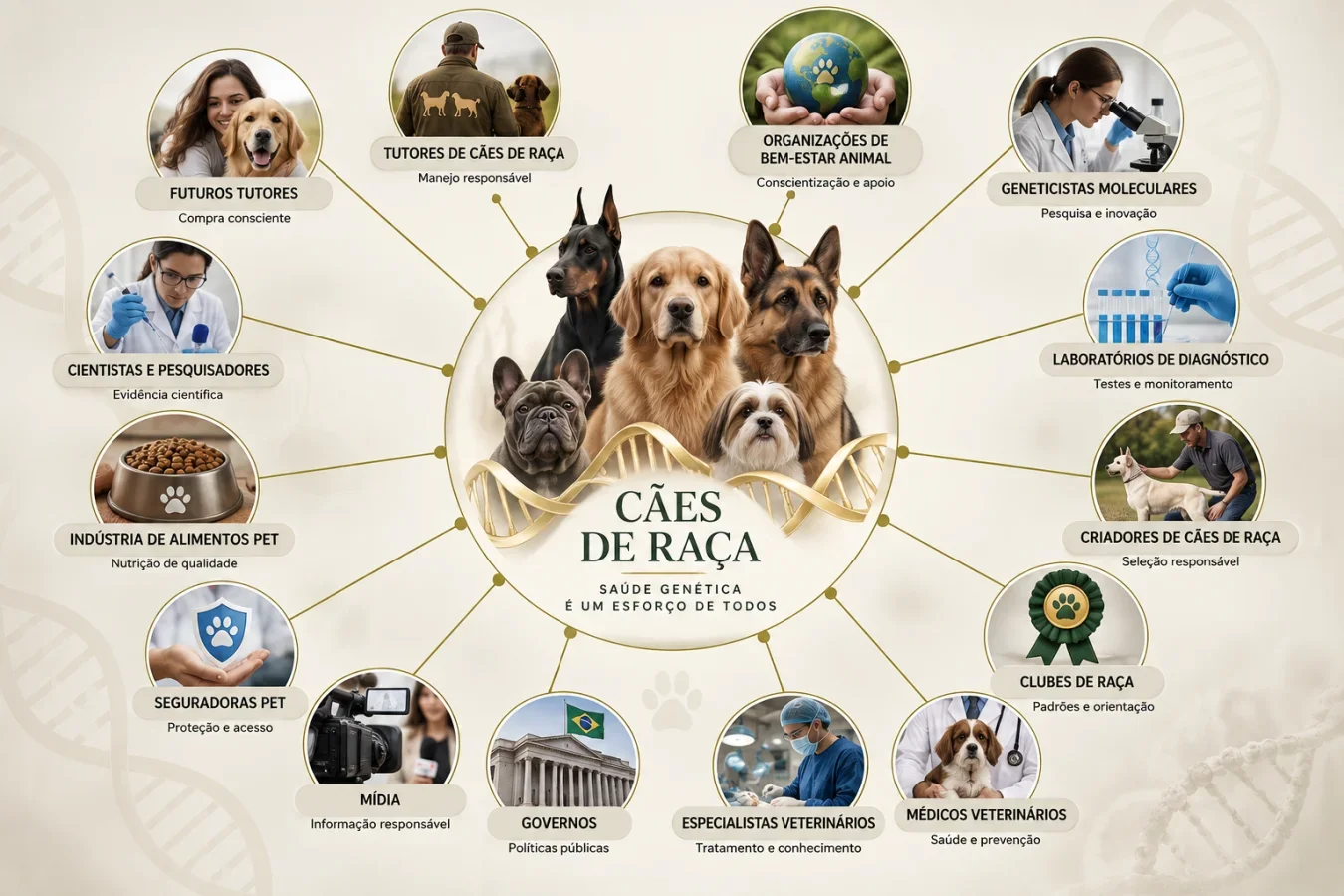
GENETIC HEALTH IS A COLLECTIVE EFFORT
It will not be enough for just one breeder to learn this new information while the others keep using the same practices.
All breeders are part of the same genetic community because they share the breed's gene pool.
As a result, improving the genetic health of dogs will necessarily be a cooperative effort.
A single extremely popular sire can cause a significant reduction in a breed's genetic diversity in just one generation.
Breeders need to recognize that they may all share the genetic consequences of this process, which may only become evident a few generations later.
That is why the text recommends that breeders seek out other professionals and breeders concerned about the future of the breed, study genetics and keep up with advances in canine genetics research.
CONCLUSION
Of everyone involved in the health of purebred dogs, those who ultimately need to solve the problem are the breeders themselves.
And that requires education.
There is a lot to learn, but the first step is to start understanding the genetics behind breeding decisions.
The future health of breeds depends not only on identifying diseases, but on understanding how breeding decisions change the genetic diversity of the whole population.
References
Farrell LL, JJ Schoenbeck, P Wiener, DN Clements, and KM Summers. The challenges of pedigree dog health: approaches to combating inherited disease. Canine Genetics and Epidemiology 2:3.
Leroy G and M Abitbol. 2010. Breeding strategies against genetic disorders in dog breeds.
Mellersh C. 2012. DNA testing and domestic dogs. Mammalian Genome 23:109-123.
Ostrander EA. 2012. Both ends of the leash, the human links to good dogs with bad genes. New England Journal of Medicine 367:636-646.
Padgett GA. 1998. Control of canine genetic diseases. Howell Book House, NY.
Rooney N and D Sargan. 2009. Pedigree dog breeding in the UK: a major welfare concern? A report commissioned by the Royal Society for the Prevention of Cruelty to Animals.