Anyone who lives with flat-faced breeds such as Pugs, Bulldogs, Shih Tzus, American Bullies and Boston Terriers knows how captivating they are. These animals quickly win over their owners with their sweet expression, friendly temperament and companionship. It is no accident that the popularity of these breeds has grown enormously worldwide in recent decades. However, along with the growing demand for and breeding of these dogs, concern about their health has also grown. What many owners and even breeders still consider a harmless breed trait, such as loud snoring or noisy breathing, is actually a sign of a serious problem: brachycephalic obstructive airway syndrome, known by the acronym BOAS.
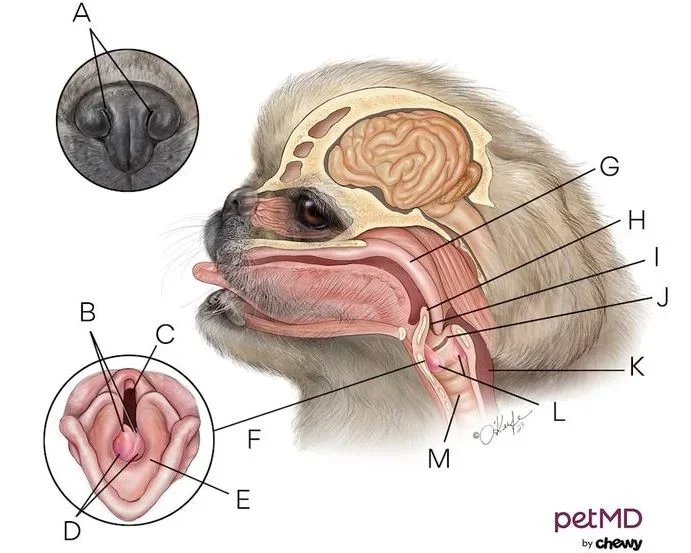
BOAS is a chronic, progressive disease that affects brachycephalic dogs precisely because of the exaggeratedly short conformation of their muzzles. As the skull is shortened, the tissues of the mouth, nose and throat do not shrink in the same proportion, resulting in a real excess of tissue in a small space. This causes a partial obstruction of the airways, making it hard for air to flow in and out. Changes such as extremely narrow nostrils, an elongated and thickened soft palate, a tongue that is large for the available space and, in some breeds, a trachea narrower than normal make up this picture. As a result, the animal has to work much harder to breathe, and this constant effort causes inflammation, wear and even collapse of the structures of the larynx over time.
Many signs of the disease are visible in daily life. The owner notices that the dog snores, breathes noisily even when awake, tires easily on short walks and often has episodes of gagging, vomiting or regurgitation. In more severe cases, the animal may have trouble sleeping, adopt strange positions such as sitting up to breathe better, or even faint on hotter days or after moderate exertion. Unfortunately, because they are so used to these symptoms, many owners believe this discomfort is simply a characteristic of the breed when, in reality, it is a clear sign of respiratory distress.
More recently, several studies have shown that BOAS should not be seen as just a breathing problem. It is now known to be a systemic syndrome that can also affect other organs. Many brachycephalic dogs have gastrointestinal disorders, such as reflux, chronic gastritis and hiatal hernia, which show up as frequent vomiting and difficulty swallowing. There are also reports of otitis media with fluid buildup in the ear, which can cause pain, itching and balance problems. Another important point is that these dogs suffer from sleep disorders similar to apnea in humans, characterized by pauses in breathing, drowsiness and tiredness during the day. In addition, there is evidence that the syndrome can lead to high blood pressure, liver changes and even a predisposition to clotting problems. This reinforces the idea that BOAS is not merely an aesthetic issue or a matter of snoring, but a disease with serious consequences for the body.
The treatment of choice is corrective surgery. The procedure usually involves widening the nostrils and reducing the excess tissue of the soft palate, allowing air to pass more easily. The age at which the dog is operated on greatly influences the result. Ideally, surgery should take place before two years of age, before serious secondary lesions have had time to develop. In cases of marked narrowing of the nostrils, some specialists recommend considering surgery as early as four to six months of age, so that the puppy grows up breathing better. Although adult dogs can also be operated on, results are generally better in young animals, while late surgery carries more risks and more limited benefits.
In recent years, technology has brought important advances. The use of the harmonic scalpel, for example, represents progress in treating dogs with BOAS. This technique uses ultrasonic vibrations to cut and coagulate at the same time, which reduces bleeding during surgery, shortens the procedure and provides a smoother, faster recovery for the patient. Studies show that surgery with the harmonic scalpel achieves results equivalent or even superior to traditional techniques, especially in terms of post-operative comfort and a lower risk of immediate complications. For owners and breeders, this means more safety and well-being for the animals.
It is important to stress that, even after surgery, the syndrome is not fully resolved. The dog needs care throughout its life. Keeping a healthy weight is essential, since obesity worsens the symptoms. Intense exercise and exposure to heat should be avoided, with walks preferably at cooler times of day. Using a harness instead of a neck collar is another practical recommendation that helps reduce breathing discomfort. In addition, associated gastrointestinal problems, such as reflux and gastritis, often need to be managed with veterinary follow-up and, in some cases, medication.
For breeders, the challenge is even greater. Genetic selection that favored ever shorter muzzles has seriously harmed the welfare of these dogs. A conscientious breeder must therefore take responsibility for not breeding severely affected animals or those that have already needed corrective surgery. Selection should favor dogs with more open nostrils, a slightly longer muzzle and good exercise tolerance, traits that can help reduce the impact of the disease on future generations. It is also essential to guide new owners on the care required and to make clear that snoring is not a charming trait, but a warning sign.
In some countries, such as the Netherlands and Norway, there are already legal measures restricting the breeding of brachycephalic dogs with very severe anatomical changes. This shows that the discussion about BOAS goes beyond veterinary medicine and into the field of ethics. After all, selecting dogs for looks without considering their welfare is something that urgently needs to be rethought.
Brachycephalic obstructive airway syndrome is a complex problem that affects breathing, sleep, digestion and circulatory health. Recognizing the signs early, intervening at the right age, investing in modern surgical techniques and maintaining lifelong care are essential measures for these dogs to live longer, more comfortable lives. For breeders, the responsibility goes even further, since they are the ones who determine the health of future generations. The commitment must be to conscientious breeding, in which health and welfare come before appearance.
In the end, the snoring of a Bulldog or a Pug should not be seen as a funny quirk, but as a cry for help. With information, responsibility and proper care, it is possible to give these dogs the full life they deserve, combining a passion for brachycephalic breeds with the assurance of health and quality of life.
Alessandra Ventura
Degree in Veterinary Medicine from the Federal University of Rio Grande do Sul (2011), master's degree (2015) and doctorate (2019) in Veterinary Sciences in small animal surgery and anesthesiology at UFRGS, with an emphasis on veterinary orthopedics and traumatology. Specialization in Small Animal Medicine and Surgery from Instituto Qualittas (2018). Currently a professor and coordinator of the graduate program in small animal orthopedics and traumatology at IBMVET, with a graduate degree in Obstetrics and Pediatrics from IEP Ranvier.