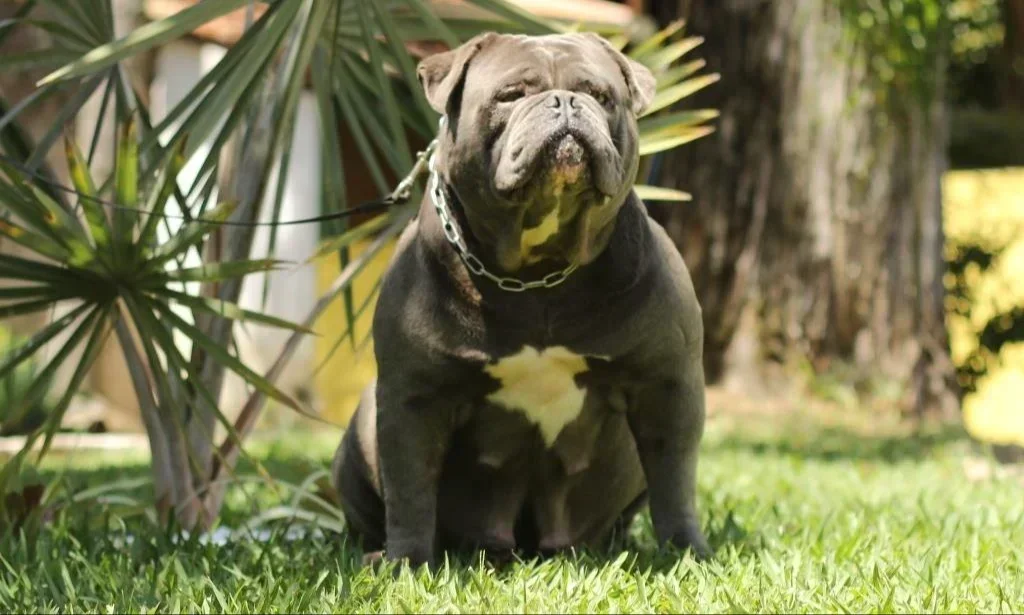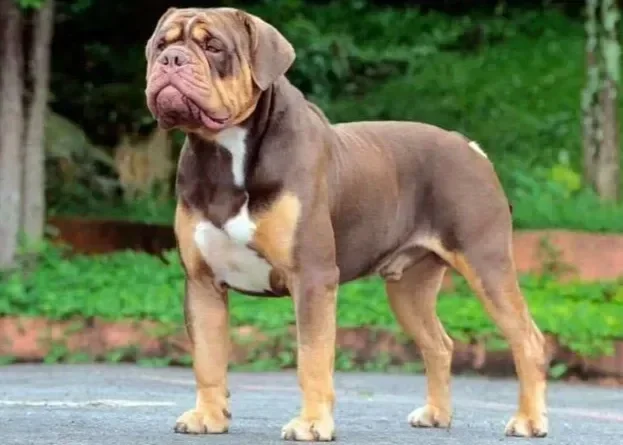
HISTORICAL SUMMARY: the Bulldog Campeiro descends from the Bulldogs brought to Brazil by immigrants from the 18th century onward. Because cattle ranching has always been strong in southern Brazil, the Bulldogs were widely used to catch the wild cattle raised in a harsh environment of open range and native forest. It took part in great cattle drives, always catching the runaway steer. In the slaughterhouses it played an active role, called on to hold an angry steer whenever needed. Working Bulldogs went through an almost natural selection: those that were too short struggled to cover long distances and could not pull back while holding the steer, and those that became too tall through crosses with other breeds lost the catching instinct and precision of movement, besides being more exposed to the cattle's kicks and horns. What was considered a good dog? The body had to be strong; the head broad with strong jaws; the muzzle broad and strong, not short like today's Bulldog's nor as long as the Bullmastiff's, so that it could bite and hold a steer regardless of its weight. A dog of watchful, calm temperament, with a marked fighting spirit and companionship. This temperament had to be so determined that it knew no limits, and so controlled that it always obeyed the drover's commands. Thus, “selected on the job”, the BULLDOG CAMPEIRO was born. so that it could bite and hold a steer regardless of its weight. A dog of watchful, calm temperament, with a marked fighting spirit and companionship. This temperament had to be so determined that it knew no limits, and so controlled that it always obeyed the drover's commands. Thus, “selected on the job”, the BULLDOG CAMPEIRO was born. so that it could bite and hold a steer regardless of its weight. A dog of watchful, calm temperament, with a marked fighting spirit and companionship. This temperament had to be so determined that it knew no limits, and so controlled that it always obeyed the drover's commands. Thus, “selected on the job”, the BULLDOG CAMPEIRO was born.
GENERAL APPEARANCE : a dog of powerful, broad build, showing strength and agility. Almost square body shape. Vigorous, muscular legs with strong bones. Voluminous head and broad chest. Imposing appearance. Viewed from above, it should be broad at the shoulders and comparatively narrow at the loin.
IMPORTANT PROPORTIONS: the height at the withers should preferably equal the length measured from the withers to the set of the tail.
BEHAVIOR / TEMPERAMENT: versatile, with guardian traits. It stands out for its loyalty to its owner, tenacity and courage. Its temperament is watchful and calm, persevering, with a marked fighting spirit and companionship. Very gentle with children; it adapts easily. Controllable, not shy, barks little, calm.
HEAD: voluminous, with good proportions; broad with strong jaws and loose skin without excessive wrinkles. The circumference of the head should be at least equal to the height and length in females, and necessarily greater in males.
CRANIAL REGION
- Skull: fairly broad, high and slightly sloping, with strong musculature. Viewed from the front, it forms a straight line between the ears when the dog is alert.
- Stop: well defined.
FACIAL REGION
- Muzzle: short, at most 1/3 and at least 1/5 of the length of the skull. Broad below the eyes; thick, with the side lines parallel to the tip of the nose; as square as possible when viewed from above.
- Nose: well formed, of good size and well pigmented.
- Ears: small, pendant, triangular; ears folded back (rose ears) are also accepted; set high and as far apart as possible. When folded lightly toward the eyes, they should not reach past the inner corner of the eye.
- Eyes: oval, medium-sized, neither deep-set nor bulging. Preferably with well-pigmented eyelids. Eye color as dark as possible, from hazel to dark brown, in dogs with a dark nose. In dogs with a red nose, lighter shades are accepted, light brown (honey color). Drooping, “weepy” eyes should be avoided.
- Lips: thick and pendulous but not excessively so; they should not hang below the lower jawline by more than 50% of the muzzle height along their entire length. The lip line should be as pigmented as possible.
- Bite: undershot, but not exceeding 3 cm.
- Jaws: broad, massive and square. The lower jaw should project beyond the upper jaw and turn up at the end.
- Teeth: strong, with canines well developed for gripping and set well apart. Incisors well aligned with the canines are preferred. Visible lower teeth are acceptable. Dentition should be as complete as possible. Visible canines, extra teeth and missing P1s are tolerated.
- Bite: undershot, but not exceeding 3 cm.
NECK: strong, of moderate length, very muscular and with a circumference close to that of the skull, with loose skin forming a dewlap, which should not be excessive.
BODY
- Back: moderately short, straight, with a slightly rising line to the croup.
- Chest: remarkably broad, almost round, its depth reaching the level of the elbows.
- Ribs: well sprung. Belly: slightly tucked up. Croup: slightly rounded.
TAIL: set low, thick at the root, of moderate length and irregular line; naturally kinked. Preference is given to a tail no longer than two thirds of the distance from the tail set to the point of the hock.
FOREQUARTERS
: vigorous and muscular, with strong bones.
- Shoulders: broad, muscular and sloping. Relative to the horizontal, they should be at 45°
- while the shoulder-upper arm angle should be less than 90°.
- Elbows: set away from the ribs, correctly pointing forward, in a vertical line measured from the elbows to the ground, in proportion to the height.
- Forearms: well developed, with strong, straight bones.
- Pasterns: moderately angulated.
- Feet: turned outward, with slightly separated, somewhat arched toes.
HINDQUARTERS: vigorous, muscular, with strong bones. Thighs: well developed, indicating vigor and activity. Hocks: slightly angulated, parallel.
- Feet: turned outward, with slightly separated, arched toes; with thick, elastic pads.
MOVEMENT: with a balanced walk, it keeps the head in line with the back and the tail low. Its movement is typical: the sway of the body should be noticeable at the croup and ribs; while walking, it keeps the back level but not rigid. Its gallop is fast, with great drive.
COAT
- Hair: short, smooth, of medium texture, neither soft nor harsh to the touch.
COLOR: all colors are accepted.
SIZE
- Ideal : males: 53 cm, females: 51 cm
WEIGHT
- males: approximately 35 kg to 45 kg
- females: approximately 30 kg to 40 kg.
The height tolerance is 48 cm to 58 cm. Weight and height proportions that give the dog a vigorous appearance must be respected.
FAULTS: Any departure from the foregoing points should be considered a fault, and the seriousness with which the fault is regarded should be in exact proportion to its degree and its effect upon the health and welfare of the dog.
MINOR FAULTS
- visible canines;
- extra teeth;
- missing P1s;
- ears set too high;
- ears too short, narrow, too wide or long;
- atypical coat;
- neck too short;
- excessive angulation of the fore and hindquarters;
- tip of the tail reaching below the hock;
- neck without dewlap or with too much dewlap;
- blue eyes.
SERIOUS FAULTS
- round or very large eyes; bulging or bicolored eyes;
- undershot jaw greater than 3 cm;
- swayed, roached or sloping back;
- weak, narrow, shallow chest;
- insufficient angulation of the fore and hindquarters;
- cow hocks;
DISQUALIFYING FAULTS
- lack of an undershot jaw;
- wry jaw;
- missing canines; missing incisors or more than 2 missing molars;
- nose more than 1/4 unpigmented;
- lack of angulation in the fore and hindquarters;
- legs too long or too short, knock-kneed or bowed;
- very heavy, labored movement, with short steps or a continuous pace;
- aggressiveness or excessive shyness.
NOTE:
- males should have two apparently normal testicles fully descended
- into the scrotum.
- any dog clearly showing physical or behavioral abnormalities shall be disqualified.