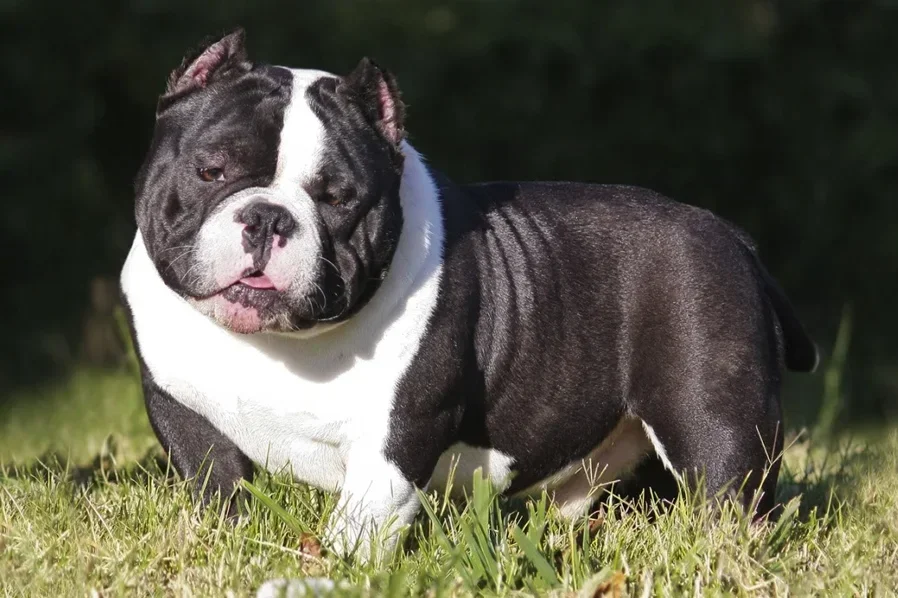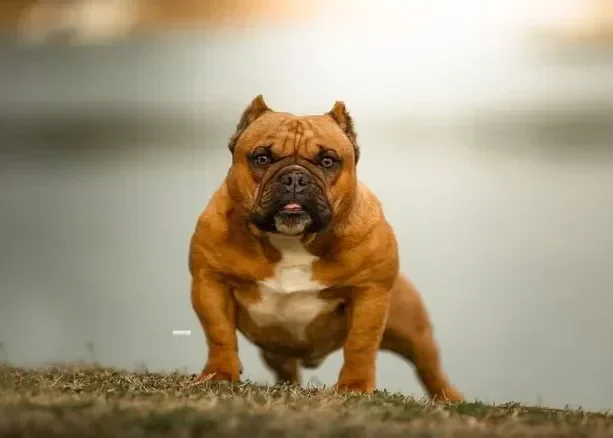
HISTORY: The Shortybull is a new line of bulldogs being bred in a miniature size. Unlike many other bully breeds bred down in size, the Shortybull does not contain Boston Terrier or Pug in its lines. These dogs are being bred for their working ability and physical traits, not just for looks.
The Shortybull was founded in a rural Kansas community by Amy Krogman and co-founder Jamie Sweet. Great care was taken to make sure this breed was not a “mini” version of any other breed, but a breed of its own with a unique look and temperament, unmatched by other small bull breeds.
The vision and goal was to develop a healthy, functional small dog breed with a stable temperament, all wrapped up in the classic bulldog look. To stay true to the vision of creating a real bulldog, Boston Terriers and Pugs were avoided in developing the Shortybull. Each breed used in the Shortybull composite was chosen for a specific trait, such as size, structure, temperament, health and ability. After years of extensive research into the many breeds that carried the traits needed and desired to develop the Shortybull, and which became the pillars of the breed, the Shortybull was finally born.
Strong consideration was also given to making sure this breed would be able to breed without assistance and whelp easily, with excellent mothering ability. Knowing that most bulldogs today have numerous health problems, great emphasis was placed on developing a dog that would leave behind the health problems of the bully breeds. Breeding a healthier dog also moved in the direction of function and ability. Your Shortybull will be able to enjoy an active lifestyle, from playing fetch in the yard to becoming a running partner, as this breed is not only willing but capable of plenty of activity. They happily take part in events such as rally obedience and agility competitions.
Although small, they are decidedly not delicate and thrive in any lifestyle, so be prepared to enjoy many healthy, active years with your Shortybull. Once you meet one, you will be a lifelong fan. It was a long journey and many years of careful breeding and record-keeping to bring to life the plan for a solid, healthy bulldog in a fun-sized package, but the journey was worth it. Only after all the groundwork was laid and the theory was well tested was the Shortybull introduced to the public, and it quickly gained a large, loyal following around the world.
The future of the Shortybull looks limitless. Through careful breeding, continued education and the development of quality programs, the Shortybull has stood the test of time from the start and continues to be everything it was envisioned to be.
HEIGHT: 15” or less (over 15” is a Disqualification)
WEIGHT: 40 pounds. Over 40 pounds is allowed but must be in proportion to height. Obesity is a fault.
HEAD: Round head with typical bulldog features. The eyes should be set well apart and not bulging. The nose should turn up slightly and may be black or liver. A Dudley nose is a cosmetic fault.
BITE: All dogs should have an underbite, but without the teeth showing.
EYES: They may be any color, but brown is preferred. The eyes should be oval and not protrude from the skull.
EARS: cropped, close to the head. In countries where cropped ears are not allowed, dogs may have natural drop or rose ears, symmetrical. Erect ears are a show-ring disqualification.
BODY: The body should be short from the withers to the tail. The chest should be broad and deep, reaching down to the elbow. A compact appearance is desired; the width of the fore and hindquarters should be in proportion, not tapering to a narrow rear. The chest may be wider than the rear, but narrow hindquarters are a fault.
SHOULDER AND LOIN: Well rounded and well muscled, giving an appearance of strength. There may be a slight rise over the loin, but not to an extreme degree.
LEGS: heavy-boned and in direct proportion to the body. Legs long in proportion to the body, or fine bones, are a serious fault. Cow hocks and pigeon toes are faults.
FEET: Tight feet and straight pasterns are desired. Splayed feet and weak pasterns are a fault.
TAIL: The tail should be short, docked or screw. Long tails are not allowed in the show ring.
COLOR: All coat colors are acceptable except black and tan and merle.
TEMPERAMENT: good-natured and even-tempered. Extreme shyness or undue aggression is a fault.