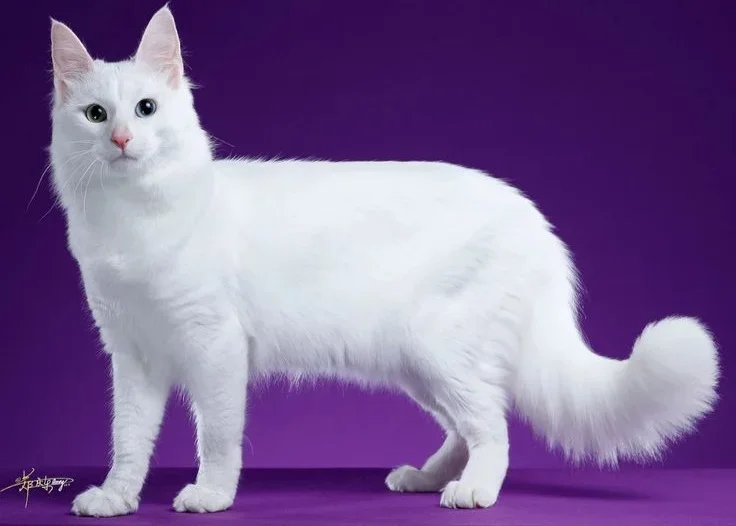
BREED STANDARD: TURKISH ANGORA (TA)
POINT SCORE
HEAD: 40 points
- Shape ............................................. 9
- Eyes ................................................ 4
- Ears .............................................. 12
- Chin ............................................... 2
- Muzzle ............................................... 2
- Profile .................................................. 5
- Neck .............................................. 4
- Nose .................................................. 2
BODY: 40 points
- Torso ............................................... 9
- Legs/Feet ......................................... 9
- Tail .................................................. 8
- Boning ............................................. 9
- Musculature ........................................ 5
COAT / COLOR: 15 points
- Coat ............................................ 10
- Color .................................................... 5
OTHER: 5 points
- Balance ............................................ 5
CLASSIFICATION
CATEGORY
Traditional.
DIVISIONS
All.
COLORS
All.
ALLOWABLE OUTCROSSES
None.
HEAD
Shape
Small to medium, smooth, a slightly modified wedge with flat planes.
Eyes
Large, walnut-shaped.
Slightly slanted upward, with an open expression.
There is no relationship between eye color and coat color, but clarity and evenness are essential.
Ears
- Large
- Broad at the base
- Tufted
- Slightly pointed
- Set high
- Vertical and upright
Chin
Firm, gently rounded, with its tip perpendicular to the nose.
Muzzle
A smooth continuation of the lines of the wedge.
Profile
Formed by two planes:
- The flat top of the head
- The nose line
They meet at an angle slightly above the eyes.
Neck
Slender, graceful, medium length.
BODY
Torso
- Long and slender
- Foreign type
- Shoulders the same width as the hips
- Medium size
- Narrow chest
- Rump slightly higher than the shoulders
Legs/Feet
- Long legs
- Hind legs longer than the front legs
- Small, oval feet in proportion
- Tufts between the toes desirable
Tail
- Tapering from a broad base to a fine tip
- Long in proportion to the body
- With a full plume
Musculature
Firm.
COAT / COLOR
Length
Semi-long, with a light undercoat, appearing single-layered.
Medium length on the body.
Texture
Silky and fine, with little undercoat.
Slightly wavy on the abdomen.
OTHER
Balance
Proportion in every physical aspect, with a graceful, light appearance.
The combination of body, legs, tail, neck, head and ears should form a harmonious whole, conveying fluid movement.
GENERAL DESCRIPTION
The ideal Turkish Angora is perfectly balanced and graceful, with a fine, silky coat.
To the touch, the contrast stands out between:
- A soft, flowing coat
- A surprisingly firm, muscular body
It is a breed that is:
- Very intelligent
- Active
- Curious
- Responds best to firm, gentle handling
In judging, refinement is more important than size, especially when comparing males and females.
ALLOWANCES
In adult males:
- Jowls
- Slightly broader head
- Wider ear set
- Larger than females
Other:
- Kittens and young cats may not have a full coat until their first winter
- The ruff and britches may take 2 to 3 years to develop
- Temporary bump on the nose/forehead in kittens
- Gentle slope in the profile
- Lockets (white spots on the chest)
PENALIZE
- Coarseness in any feature
- Broad chest, hips or shoulders
- Heavy boning
- Break in the profile
- Very pronounced whisker pads
- Pinched muzzle
WITHHOLD AWARDS (WW)
- Cobby body
- Excessively oriental head or body
TEMPERAMENT
Must be gentle.
Defiant behavior results in disqualification.
DISQUALIFICATIONS (DQ)
According to Article 16, including:
- Biting
- Fraud
- Cryptorchidism
- Absence of tail
- Irregular polydactyly
- Strabismus
- Blindness
- Incompatible size
- Sternal abnormalities