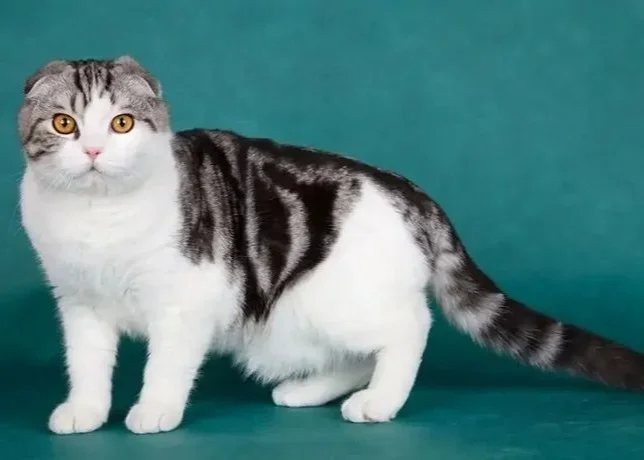
SCOTTISH FOLD / SCOTTISH STRAIGHT BREED GROUP (SF / SFL / SCS / SCL)
GENERAL DESCRIPTION OF THE BREED
Scottish cats are best known for the Scottish Fold (SF), with its characteristic folded ears and large round eyes that give a sweet, open expression.
- Scottish Fold Longhair (SFL): longhaired version of the Fold.
- Scottish Straight (SCS): straight-eared version of the Fold.
- Scottish Straight Longhair (SCL): straight-eared, longhaired version.
POINT SCORE
HEAD: 40 points
- Shape: 10
- Eyes: 5
- Ears: 15
- Muzzle: 3
- Nose: 3
- Chin: 1
- Profile: 3
BODY: 40 points
- Torso: 5
- Legs: 4
- Feet: 3
- Tail: 20
- Boning: 3
- Musculature: 5
COAT / COLOR / PATTERN: 15 points
- Length: 4
- Texture: 5
- Pattern: 3
- Color: 3
OTHER: 5 points
- Balance: 2
- Condition: 2
- Temperament: 1
CLASSIFICATION
- Category: All
- Division: All
- Color: All
Allowable Outcrosses
- American Shorthair
- British Shorthair
- British Longhair
HEAD STANDARD
Shape
Well rounded.
Prominent cheeks, with a “jowly” appearance.
The overall appearance should be sweet and open.
It should be round from every angle.
Eyes
Wide open, large and round, with a sweet expression.
Eye color should conform to the coat.
Ears (Fold)
Folded forward and downward.
Small, tightly folded ears are preferred.
They should sit like a “cap”, exposing the rounded skull, not set high on the head.
Size is less important than placement and fold.
Rounded tips.
Ears (Straight)
Medium to small, with rounded tips.
Set wide apart, showing the rounded top of the head.
Muzzle
Moderately broad, with well-rounded whisker pads.
Nose
Broad and short.
Chin
Moderate.
Profile
Gentle curve; a short stop is allowed.
Neck
The head should blend into a short neck.
BODY STANDARD
Torso
Medium, well-rounded body.
It should be even from the shoulders to the pelvis.
Legs
Length in proportion to the body.
The cat should stand firm, with no signs of weakness or lack of mobility in the hindquarters.
Feet
Neat, well-rounded toes.
Tail
It should have normal flexibility and be in proportion to the body.
Boning
Medium.
Musculature
Firm, muscular body, with no signs of flabbiness.
COAT / COLOR / PATTERN
Length
(SF / SCS)
Short, preferably double.
It should not lie flat against the body.
(SFL / SCL)
Semi-long.
Toe tufts and ear furnishings should be visible.
A ruff and britches are desirable.
Texture
(SF / SCS)
Plush, dense and resilient.
(SFL / SCL)
Soft and standing away from the body.
Pattern
All patterns.
Color
All colors are accepted.
OTHER CRITERIA
Balance
Medium body, well balanced and in proportion.
Condition
The cat should be in healthy condition.
Temperament
Gentle.
The Scottish Fold is affectionate and easygoing, and enjoys human company.
GENERAL DESCRIPTION (IDEAL)
The Scottish Fold arose as a spontaneous mutation in farm cats in Scotland.
All true Scottish cats trace their pedigree back to Susie, the first folded-ear cat discovered by William and Mary Ross.
The breed was later established by crosses with registered breeds and domestic cats in the United States.
One word describes the Scottish: ROUND, in every sense.
Rounded head, body, eyes and feet.
It is known for its distinctive ears and large round eyes, which give it a sweet, open expression.
It keeps a “kitten-like” look throughout its life.
The Shorthair is medium-sized, with a plush, dense coat.
The Longhair follows the same standard, except for the semi-long coat standing away from the body, giving a softer overall look.
The Scottish Straight is identical, keeping the same sweet expression, but with upright ears.
ALLOWANCES
- Seasonal variations in coat length and texture in longhairs
- Lockets
PENALIZE
- Heavy brow that “closes” the face, giving a frowning look
- The forehead should be smooth
- A definite nose stop is considered a fault
- Any sign of lack of mobility due to short, thick legs
WITHHOLD AWARDS (WW)
- Evidence of illness
- Poor health
- Emaciation
DISQUALIFICATION (DQ)
- Kinked tail
- Inflexible tail
- Shortened tail (in the normal position it does not reach the table)
TEMPERAMENT AND GENERAL DISQUALIFICATIONS
Temperament must be gentle.
Any sign of aggression results in disqualification.
Mandatory disqualifications include:
- Biting
- Fraud
- Males without two testicles
- Unauthorized absence of tail
- Unauthorized polydactyly
- Tail defects (where required)
- Strabismus (where required)
- Total blindness
- Incompatible size
- Chest deformity