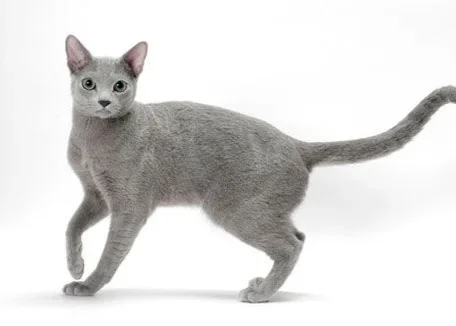
RUSSIAN BLUE BREED STANDARD (RB)
COLOR
Even, lustrous blue.
POINT SCORE
HEAD: 33 points
- Shape ........................................ 15
- Ears .......................................... 5
- Eyes ............................................. 10
- Neck ......................................... 3
BODY: 27 points
- Torso ............................................ 15
- Tail ............................................ 5
- Legs ........................................... 5
- Feet ................................................ 2
COAT / COLOR / PATTERN: 40 points
- Color ................................................. 20
- Texture ............................................ 20
CATEGORY: Traditional
DIVISION: Solid
COLOR: Blue Only
ALLOWABLE OUTCROSSES: None
HEAD
Shape
Modified wedge made up of seven flat planes, namely:
- A vertical line from the tip of the nose to the base of the chin
- The profile from the tip of the nose to the forehead
- The flat top of the head, from the forehead back
- The right side plane of the muzzle
- The left side plane of the muzzle
- The plane of the right cheekbone
- The plane of the left cheekbone
Profile
Straight nose and flat forehead, forming two planes.
Muzzle
Medium length.
Muzzle Break
None.
Skull
Flat, narrow top; high forehead.
Chin
Continuous vertical plane, from the tip of the nose to the base of the chin.
Ears
Almost as wide at the base as they are tall.
- Pointed in appearance, with slightly rounded tips
- Relatively large
- Set as much on the side as on the top of the head
- Outside covered with short, fine hair
- Inside with furnishings covering about half of the ear
Eyes
Relatively large, almost round, slightly oval, with a subtle oriental slant.
- Set well apart
- Green in adults
- In kittens, they change from yellow to green
Neck
Long and slender (may look shorter because of the dense coat).
BODY
Torso
Foreign type.
- Length: long
- Size: males proportionally larger
- Boning: fine
Note: the density of the coat may give a sturdier look, without indicating heavy boning.
Musculature
Agile, slender, firm, with solid weight and no excess bulk.
Legs
Long, fine, firm and lithe.
Feet
Small, well rounded, giving the look of walking on tiptoe.
Tail
Long, straight, tapering gradually from a relatively thick base to a fine tip.
COAT: TEXTURE
Length
Short.
Texture
Fine, soft and silky.
Density
Double coat, dense and plush.
Silver Tipping
The guard hairs have silver tips.
- The deeper the tipping, the better
- The cat looks lighter in color
- The effect is not caused by the silver (Inhibitor) gene
Ghost tabby markings are allowed in kittens.
GENERAL DESCRIPTION
The Russian Blue is a distinctly elegant cat with a foreign body type and a modified-wedge head formed by seven planes.
The slightly upturned corners of the mouth give a gentle, smiling expression.
Its most striking feature is the double coat:
- Short
- Silky
- Standing up
- Medium blue with silver tips
The coat reflects light, creating a silvery sheen.
The silver hairs should contrast with the solid blue ground when brushed against the grain.
The color should be an even blue, with deeper tipping preferred.
Ghost tabby markings are accepted in kittens.
- Nose: charcoal gray
- Paw pads: light pink
- Eyes: vivid green at maturity
By 4 months, a green ring should appear around the pupil.
Cats with no green in the eyes receive the maximum penalty.
Temperament: gentle, shy, soft voice.
PENALIZE
- Weak chin
- Eyes not fully green
- Maximum penalty for eyes without any green
WITHHOLD AWARDS (WW)
- White spots or lockets
DISQUALIFICATION (DQ)
According to the Show Rules, Article 16:
- Biting during judging
- Attempted fraud
- Males without two descended testicles
- Total or partial absence of the tail
- Polydactyly outside the standard
- Visible or invisible tail defects
- Strabismus
- Total blindness
- Size too small for the breed
- Sternal depression or abnormal chest