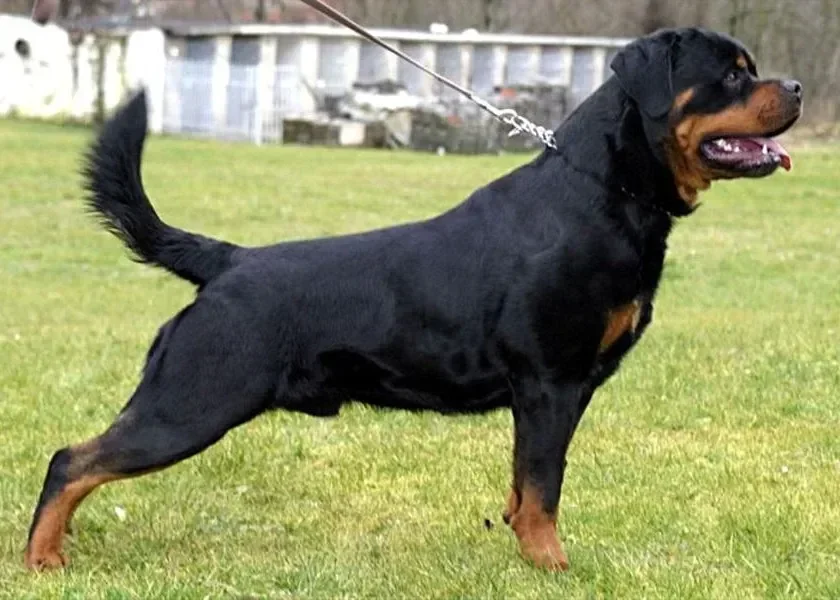
BRIEF HISTORICAL SUMMARY: The Rottweiler is one of the oldest breeds. Its origin goes back to Roman times, when it was kept as a guard and herding dog. These dogs moved with the Roman legions across the Alps, guarding the men and driving the cattle. Around Rottweil, they met the native dogs of the region, and the two interbred. The Rottweiler's main task once again became driving and guarding large herds of big livestock and defending its owner and their property. It got its name from the old town of Rottweil: Rottweiler Metzgerhund (Rottweil butcher's dog). The butchers bred this dog purely for its performance and usefulness. Over time, this droving dog came to be used more as a draft dog. At the beginning of the century, when various breeds were tried for police work, the Rottweiler was also tested. It soon proved highly suited to police service duties. For this reason, in 1910 it was officially recognized as a police dog. Rottweiler breeding aims at a strong dog, black with clearly defined reddish-brown markings, which, despite its powerful overall appearance, does not lack nobility and is exceptionally well suited as a companion, protection and working dog.
GENERAL APPEARANCE: It is a sturdy, medium to large dog, neither light, coarse, leggy nor racy. Its build, in correct proportions, forms a compact, strong, well-proportioned figure, showing power, agility and endurance.
IMPORTANT PROPORTIONS: The length of the body, measured from the point of the sternum to the ischial tuberosity, should not exceed the height at the withers by more than 15%.
BEHAVIOR / TEMPERAMENT: It is basically friendly and peaceful, very devoted, fond of children, easy to handle and eager to work. Its appearance shows a natural, rustic quality; it is self-assured, with courage and steady nerves. Always attentive to its surroundings, it reacts with great alertness.
HEAD
Skull: Of medium length, broad between the ears. Viewed in profile, the forehead line is moderately arched. The occipital bone is well developed without being too prominent.
Stop: Well defined.
FACIAL REGION
Nose: Well developed, more broad than round, with relatively large nostrils and always black.
Muzzle: Should appear neither elongated nor short in proportion to the skull. Straight nasal bridge; broad at the base, tapering moderately toward the nose.
Lips: Black, close-fitting, corners of the mouth closed, gums preferably dark.
Jaws / Teeth: Strong and broad. Full dentition (42 teeth); the incisors meet in a scissor bite.
Cheeks: Well-developed zygomatic arches.
Eyes: Medium-sized, almond-shaped, deep brown, with close-fitting eyelids.
Ears: Medium-sized, pendant, triangular, wide apart, set high. The skull appears broader when the ears are carried forward and lie close to the cheeks.
NECK: Strong, of fair length, well muscled, with a slightly arched
topline; clean, without dewlap or loose skin.
BODY
Back: Straight, firm and strong. Loin short, strong and deep.
Croup: Broad, of medium length, slightly rounded and of medium slope.
Chest: Roomy, broad and deep (approximately half the height at the withers), with a well-developed forechest and well-sprung ribs.
Belly: Underline not tucked up.
TAIL: In its natural state, it is level, as an extension of the topline; at rest it may hang down.
FOREQUARTERS
General: Viewed from the front, the legs are straight and moderately wide apart. Viewed from the side, the forearms are straight and vertical. The shoulder blades form an angle of about 45° with the horizontal.
Shoulders: Well laid back.
Upper arms: Close to the body.
Forearms: Strongly developed and muscular.
Pasterns: Strong, slightly springy and sloping.
Feet: Round, tight and arched. Hard pads; short, black, strong nails.
HINDQUARTERS
General: Viewed from behind, the legs are straight and moderately wide apart. In a natural stance, the thigh forms an obtuse angle with the croup and with the lower thigh, as does the lower thigh with the hock.
Thighs: Fairly long, broad and strongly muscled.
Lower thighs: Long, strong, extensively muscled, powerfully driving the strong, well-angulated hocks, never too open in angle.
Feet: The hind feet are slightly longer than the front feet, but equally tight and arched, with strong toes.
GAIT / MOVEMENT: The Rottweiler is a trotting dog. The back remains firm and relatively still. The movement is harmonious, steady, powerful and unhindered, with good stride length.
SKIN
Skin of the head: Tight-fitting; it may show slight wrinkles when the dog is alert.
COAT: Made up of outer coat and undercoat. Outer coat stiff, of medium length, coarse, dense and flat. On the hind legs the coat is slightly longer. The undercoat must not show through the outer coat.
COLOR: Black, with clearly defined markings of a rich tan on the cheeks, muzzle, throat, chest and legs, as well as over the eyes and under the base of the tail.
SIZE / WEIGHT
Height at the withers for males: 61 to 68 cm.
61 to 62 cm small.
63 to 64 cm medium.
65 to 66 cm large = ideal height.
67 to 68 cm very large.
Weight: 50 kilograms.
Height at the withers for females: 56 to 63 cm.
56 to 57 cm small.
58 to 59 cm medium.
60 to 61 cm large = ideal height.
62 to 63 cm very large.
Weight: Approximately 42 kilograms.
FAULTS: Any departure from the foregoing points should be considered a fault, and the seriousness with which the fault is regarded should be in exact proportion to its degree and its effect upon the health and welfare of the dog.
General appearance: Light, racy, leggy; weak musculature and bone.
Head: “Hound-like” expression, too narrow, light, too short, long or heavy; flat forehead (little or no stop).
Muzzle: Long muzzle, Roman nose or split nose; dished or sloping nasal bridge; light or spotted nose.
Lips: Open, pink or spotted; corners of the mouth open.
Jaws: Narrow lower jaw.
Cheeks: Excessively pronounced.
Teeth: Level (pincer) bite.
Ears: Set too low, heavy, long, folded back, or hanging open or poorly carried.
Eyes: Light, deep-set or round. Drooping eyelids.
Neck: Too long, thin, poorly muscled, dewlap or loose skin at the throat.
Body: Too long, too short or too narrow.
Chest: Narrow, flat ribs, barrel-shaped.
Back: Too long, weak, swayed or roached.
Croup: Too short, too flat, too sloping or too long.
Tail: Set too high or too low.
Forequarters: Front legs too close together or not straight. Loose shoulders; elbows loose or turned out; upper arm too long, too short or too straight;
weak or straight pasterns. Splayed feet; flat or overly arched toes, stunted toes; light nails.
Hindquarters: Flat thighs, hocks too close together, cow hocks or barrel legs, angulation too closed or too open, dewclaws.
Skin: Wrinkled skin on the head.
Coat texture: Soft, too short or too long; wavy coat, lack of undercoat.
Color: Markings of the wrong color, poorly defined or too extensive.
DISQUALIFICATIONS
General: Clearly reversed sexual characteristics (feminine males and vice versa).
Teeth: Undershot, overshot, wry mouth; dogs missing 1 molar, 1 premolar, 1 canine or 1 incisor.
Eyes: Yellow; each a different color; entropion, ectropion.
Tail: Kinked, curled, strongly deviated to the side.
Coat: Clearly long or wavy coat.
Color: Lack of the typical Rottweiler black-and-tan markings; white markings.
Behavior: Fearful, shy, cowardly, gun-shy, overly suspicious or nervous.
Any dog clearly showing physical or behavioral abnormalities shall be disqualified.
NOTES:
Male animals should have two apparently normal testicles fully descended into the scrotum.
Only functionally and clinically healthy dogs with breed-typical conformation should be used for breeding.