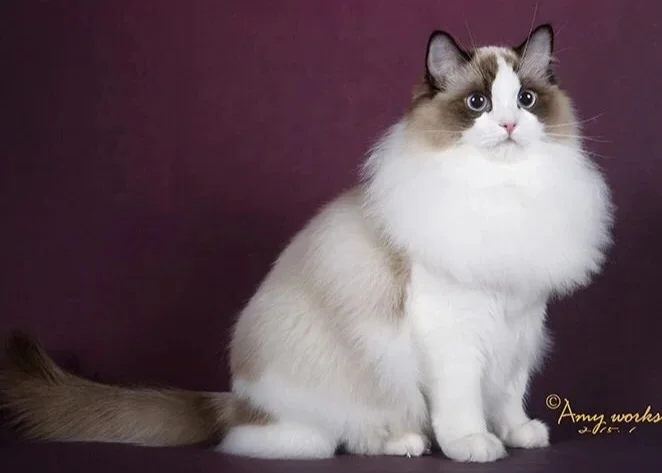
RAGDOLL / CHERUBIM BREED GROUP (RD/CB)
GENERAL DESCRIPTION OF THE BREED
The Ragdoll (RD) is a large, semi-longhaired cat with blue eyes, pointed pattern and moderate type.
The Cherubim (CB) is a large, semi-longhaired cat in mink, sepia or traditional colors, with moderate type.
POINT SCORE
HEAD: 40 points
- Shape: 9
- Ears: 5
- Eyes: 7
- Chin: 5
- Muzzle: 4
- Profile: 9
- Neck: 1
BODY: 35 points
- Torso: 8
- Legs / Feet: 5
- Tail: 4
- Boning: 10
- Musculature: 8
COAT / COLOR / PATTERN: 25 points
- Length: 4
- Texture: 8
- Pattern: 6
- Color: 7
CLASSIFICATION
- Category:
- RD: Pointed
- CB: Mink, Sepia and Traditional
- Divisions:
RD:- Solid Point
- Tortie Point
- Tabby Point
- Solid Point/White, Tortie Point/White, Tabby Point/White
(mitted and bicolor patterns only)
- CB:
- Solid
- Tortie
- Tabby
- Solid & White, Tortie & White, Tabby & White
(mitted and bicolor patterns only)
- Colors:
- RD: All pointed colors
- CB: All Mink, Sepia and Traditional colors, except solid white
- Allowable Outcrosses: None
HEAD STANDARD
Shape
Broad modified wedge, with slightly rounded contours, showing the appearance of a flat plane between the ears when viewed from the front. Medium-sized skull.
Ears
Medium, broad base, rounded tip. Set both on the top and on the sides of the head, slightly tilted forward.
Eyes
Large, oval. Level setting; moderately spaced.
Emphasis should be placed on correct shape, size and placement.
Deeper shades are preferred in all colors.
- RD: Blue
- CB · Mink: Blue-green to green-blue (aqua)
- CB · Sepia: Gold, greenish gold (chartreuse) or green
- CB · Traditional: Bronze, copper, gold, yellow-green or hazel
Chin
Well developed, with good depth, forming a perpendicular line with the upper lip and the tip of the nose.
Muzzle
Rounded, medium length, in line with the wedge.
Profile
Straight line from the nose to the bridge, followed by a concave curve up to the brow area. Convex curve up to the forehead. Appearance of a flat plane between the ears.
Neck
In proportion to the head and torso.
BODY STANDARD
Torso
Medium-long to long, substantial. Broad chest.
A “fat pad” on the lower abdomen is acceptable.
Females may be smaller than males.
Legs
Substantial boning, in proportion to the body; hind legs slightly longer than the front legs.
Feet
Large, rounded; tufts desirable.
Tail
As long as the body. Thicker at the base, with a slight taper.
Boning
Substantial.
Musculature
Well muscled, with solid weight.
COAT
Length
Semi-long. Allow for shorter coats in whole (unaltered) adults and seasonal variations.
Correct texture is more important than length.
Texture
Silky and soft. A minimal undercoat gives body, but the coat should fall smoothly.
It should be neither woolly nor cottony.
COLOR / PATTERN
SOLID POINT / SOLID DIVISION
(RD) Pointed:
Ears, mask, legs, feet and tail should be darker, with well-defined color.
The chest (bib) and chin may be slightly lighter.
Lighter, even body color, with minimal shading.
Gentle shading allowed.
There should be a definite contrast between body and points.
Allow for a darker body in older cats and color not yet developed in young cats.
(CB) Mink:
Medium, even body tone, contrasting with the points.
Allow for a darker body in older cats and undeveloped color in kittens/young cats.
(CB) Sepia:
Body color closer to the extremities, with less contrast.
Allow for a darker body in older cats and undeveloped color in kittens/young cats.
(CB) Traditional:
Even solid color for solid coats.
“ANY COLOR AND WHITE” DIVISION
MITTED PATTERN
Head:
May have a broken or even white blaze on the nose and/or between the eyes.
White should not reach the inner corner of the eye, the nose leather or the whisker pads.
The chin must be white.
Front feet:
Symmetrical white “mittens”, not going past the bend of the paw.
All toes must be white.
Hind legs:
White goes up to and around the hocks, not going past mid-thigh.
Body:
White stripe from the chin across the chest and along the entire abdomen.
BICOLOR PATTERN
Head:
A white inverted “V” that fully surrounds the pink nose leather and does not go past the outer edge of the eyes on either side.
The “V” should be as symmetrical as possible.
White chin.
Body:
White chest, abdomen and ruff.
The “saddle” may include white or shading in the body color.
Feet and legs:
Fully white preferred.
Paw pads:
Pink preferred.
GENERAL DESCRIPTION (IDEAL)
The ideal cat of this group is a large, semi-longhaired cat with a sweet personality.
Moderate type, well balanced, without extremes, with no feature dominating another.
It grows large and heavy, but matures slowly and may not reach full size and weight until 4 years of age.
Full color may not set in until 3 years of age.
It is a muscular cat with little fat, except for the “fatty pad” on the lower abdomen.
ALLOWANCES
General
- Seasonal variations in coat length
- Shorter coat in whole adults and in kittens
- Females smaller than males
Mitted and Bicolor patterns only
- Feet and legs: small spots of point color in areas designated as white
- Pads: point-colored spots or colored pads
PENALIZE
General
- Very small ears
- Any eye shape other than oval
- Roman nose
- Straight profile
- Cobby body
- Short legs
- Short tail
- Woolly/cottony texture
Mitted
- No white stripe on the abdomen
- White on the ears and/or tail
Bicolor
- White going past the outer edge of the eye
- White on the ears and/or tail
WITHHOLD AWARDS (WW)
General
- Doming of the skull
- RD: any eye color other than blue
- CB Mink: any eye color other than aqua (blue-green to green-blue)
- CB Sepia: any eye color other than gold, greenish gold (chartreuse) or green
- CB Traditional: any eye color other than bronze, copper, gold, yellow, green or hazel
Pointed
- Any white
Mitted
- No white chin
Bicolor
- Any dark mark within the white “V”, including the chin
DISQUALIFICATION (DQ)
- Strabismus
- Visible or severe tail defects
- Severe cow hocks
TEMPERAMENT AND GENERAL DISQUALIFICATIONS
Temperament must be gentle.
Any sign of aggression results in disqualification.
Mandatory disqualifications include:
- Biting
- Fraud
- Males without two testicles
- Unauthorized absence of tail
- Unauthorized polydactyly
- Tail defects (where required)
- Strabismus (where required)
- Total blindness
- Incompatible size
- Chest deformity