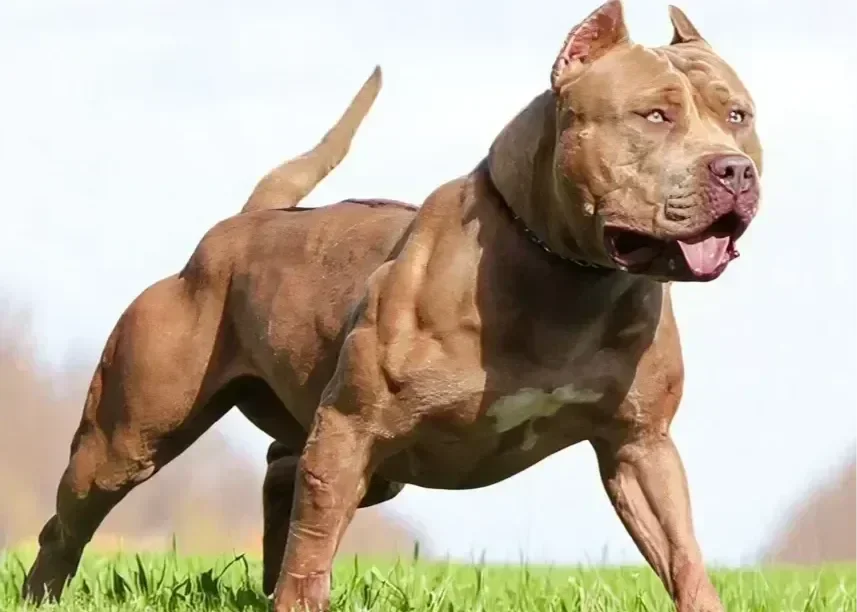
Pit Monster
A few years ago this wonderful breed emerged: dogs with great mass and an appearance similar to the APBT, nicknamed “Pit Monster” by breeders. However, the differences between this breed and traditional APBTs are many (especially its gentle temperament and enormous mass), so in 2017 IBC concluded that recognizing a new breed was the most appropriate way to settle the matter.;
Since 2017 IBC has regulated “Pit Monsters” as a breed, allowing them to follow their own path, with thousands of admirers around the world.
Selection and the search for sturdier dogs became so intense among breeders that in 2023 IBC saw the need to divide the breed in competitions into Standard Type and Extreme Type. This division applies only in the conformation ring; the breed remains a single breed, and the types may share the gene pool.
In February 2025 IBC joined breeders to define a more fitting name, one that referred properly to the breed and conveyed the perception of a gentle breed, not an intimidating one as the previous name suggested. A new name emerged: “Brazilian Bull”, a name that celebrates the breed's origin, makes international acceptance easier and conveys an imposing presence.
Goals:
1- To give “Pit Monsters” a place at events and shows and to describe their own breed standard.
2- Separating the types allows the more modern dogs (Extreme) and the more traditional dogs (Standard) to have a place in competitions and to take part in the selection program without harming the gene pool and health of the breed.
3- Separating the types allows the more modern dogs (Extreme) and the more traditional dogs (Standard) to have a place in competitions without creating another breed, which would harm the gene pool and health of Pit Monsters.
The goal of every “Pit Monster” breeder should be to achieve perfection, aiming for the breed's health, type and temperament.
According to IBC, the breed should have the following characteristics:
Pit Monster - Standard Type
General Description: The ideal “Pit Monster” is a loyal, lovable dog; as the name suggests, these dogs show great strength. With a large head in proportion to its muscular body, the “Pit Monster” should have one of the most muscular physiques among dog breeds, combining endurance and strength. Aggressive behavior toward people is not characteristic of the breed and is therefore highly undesirable.
Characteristics: The dogs should have an extremely strong, vigorous build, with hypertrophied, very well-defined musculature. Solidly built and short-coated, the body should be slightly longer than it is tall, and females may be a little longer than males. The head should be large, of medium length, with a flat skull and a broad muzzle tapering gently to the nose. The ears are small to medium in size, set high, and may be natural or cropped. The tail is set low, thick at the base and tapering toward the tip. The “Pit Monster” comes in all colors and markings.
Its essential characteristic is its loyal, very stable and confident temperament. The breed loves to please its owners and has a zest for life; they are excellent companion dogs. The breed's extreme strength makes it one of the sturdiest canines, so they need careful owners.
It is very important that “Pit Monsters” be athletic and healthy. The dogs should be free of breathing problems and able to enjoy outdoor activities without concern, except in extreme heat or cold.
Head: The head is a key element of breed type. In the Standard Type, the head viewed from above should look triangular and slightly flat, with all its musculature very pronounced. Viewed from the front, it should show very developed cheekbones and cheek muscles. The median furrow should be moderately sunken between the eyes. Viewed from the side, the skull and muzzle are parallel to each other, joined by a moderately defined stop at an angle between 45 and 60 degrees. The brow ridges over the eyes are well defined.
The circumference of the head should be greater than the dog's height at the withers. A narrow head, or one that looks too small for the body, is a fault.
Muzzle: The muzzle is broad and deep, with a very gentle taper from the stop to the nose. The length of the muzzle is shorter than the length of the skull, in a ratio of about 2:3 in relation to the total length of the head. The lower jaw is well developed, broad and deep. The lips are dry and tight. The nose is large, with wide, well-opened nostrils, with no sign of restricted airflow. The nose may be any color. A complete lack of pigment is considered a fault.
Dentition: The Pit Monster should preferably have a full set of evenly spaced, white teeth meeting in a scissor bite. Faults: Level bite, reverse scissor bite, slight undershot bite, missing teeth. Serious Faults: Pronounced undershot bite, overshot bite, wry jaw.
Eyes: The eyes are medium-sized, almond to triangular in shape, set apart, showing a strong expression with a piercing gaze. Any color is acceptable except wall eyes, which should be considered a fault. Deformed, bulging, squinting, crossed and asymmetrical eyes are considered a very serious fault.
Ears: The ears are set high and may or may not be cropped. If left natural, rose ears are preferred. Drop ears are acceptable, as long as they are small and do not resemble those of a “hound”. Fully erect ears set on top of the head should be considered a serious fault.
Neck: The neck is of medium length and very muscular. It shows a marked arch where it joins the head. The neck widens gradually as it descends from the cervical region to where it joins well-angulated shoulders.
Body: The chest is deep, full and broad. The ribs are well sprung, forming a strong, broad, muscular body. The back is strong and firm, sloping slightly from the withers to a broad, muscular croup (slightly descending). A level back is acceptable. The hindquarters should be broad and muscular.
Forequarters: The front legs are strong and muscular, with significant bone mass. They should be straight and well apart; the shoulders should be well placed, well angulated, broad and muscular. The elbows fit close to the body. The pasterns are powerful, straight and flexible. Lack of bone mass is very undesirable. Loose elbows and legs turned in or out (east-west) are a fault.
Hindquarters: The hindquarters are strong, muscular and broad. The angulation of the bones and musculature of the hindquarters should be in harmony with the forequarters. The thighs should be well developed, with thick, well-defined muscles. Viewed from the side, the hocks are well angulated, and the hind legs should show good angulation to allow good movement. Cow hocks and straight, poorly angulated legs are a serious fault.
Feet: The feet are round, in proportion to the size of the dog, and should be well arched and tight. The pads are hard and tough. Weak pasterns and/or splayed feet are serious faults.
Tail: The tail is set on as a natural extension of the topline and tapers toward the tip. When the dog is relaxed, the tail is carried low and reaches almost to the point of the hock. When the dog is moving, it carries the tail level with the topline. When excited, the dog may carry the tail raised. Short, curled or docked tails are unacceptable.
Skin / Coat: The coat should be short, glossy and smooth, over thin, tight skin. Thick, molosser-style skin and excess skin will be considered a serious fault.
Colors: Any color or color distribution, as well as any combination of colors, is accepted.
Height and Weight: The “Pit Monster” should be powerful, so its weight and height are less important than the correct proportion between height and weight; however, males between 50 and 65 cm and females between 45 and 60 cm at the withers are desirable. The desirable weight of an adult male in good condition should exceed 45 kg. The desirable weight of a mature female in good condition should exceed 40 kg. Dogs below the measurements mentioned should not be penalized unless they are weak, lacking in mass or light-boned; large dogs with good body and muscle mass are desirable. Fat dogs are not desirable. The musculature should be visible.
Movement: The “Pit Monster” moves with a confident attitude; at the trot, its movement is powerful. The dogs should have a balanced gait, with good rear drive complemented by ample reach of the front legs, allowing the dog to cover ground powerfully. The dogs should trot on their own; dogs that have to be coaxed to walk or that are dragged “like a crab” are considered a fault. Viewed from any side, the legs turn neither in nor out, and the feet neither cross nor interfere with each other.
FAULTS: Any departure from this standard should be considered a fault and penalized in proportion to its severity and its effects on the dog's health.
DISQUALIFYING FAULTS:
Any dog showing any sign of aggression toward people.
Serious structural deviations or signs of abnormalities.
Extreme difficulty moving.
Insufficient breed characteristics, so that the dog as a whole does not sufficiently resemble other members of its breed.
Narrowed nostrils.
Long coat
Males that do not have two apparently normal testicles fully descended into the scrotum.
Pit Monster - Extreme (Oversize)
Follow the original standard, taking into account the following differences:
General Description: The “Pit Monster Extreme” is a more exaggerated version of the standard Pit Monster; in this category the dogs look sturdier, with broad, heavy bones, and some traits from the Bulldogs that went into the breed's development can be seen.
Head: With a large, powerful head, the “Pit Monster Extreme” should have the largest head proportion among dog breeds, with great bone mass and hyperdeveloped musculature. Because of the hypertrophy of the muscles in the front of the skull, the median furrow is pronounced between the eyes. Viewed from the side, the skull and muzzle are parallel to each other, joined by a well-defined stop at an angle between 60 and 90 degrees.
The circumference of the head should be about 10 cm greater than the dog's height at the withers. The head should never look narrow and small compared to the body.
Muzzle: The muzzle is broad and deep. The length of the muzzle is shorter than the length of the skull, in a ratio of about 1:2 in relation to the total length of the head. The lips may be slightly pendulous.
Eyes: The eyes are medium-sized and may be almond-shaped or slightly rounded.
Forequarters: The front legs are strong and muscular, with great bone mass. They should be set well apart; a slight bow is accepted as long as it does not impair movement. The shoulders should be well placed, well angulated, broad and muscular. The elbows do not need to fit close to the body.
Skin: Thin, tight skin is preferred; however, thicker skin is not considered a fault. Loose, molosser-style skin is considered a serious fault.
Height and Weight: In the “Pit Monster Extreme”, dogs are expected to weigh about 10% more than “Pit Monster Standard” dogs of the same height. Fat dogs are not desirable; the extra weight refers to greater muscle mass and sturdier bone. Weak dogs, dogs lacking in mass or light-boned dogs should be penalized.
All rights reserved to IBC; this information may not be copied or altered. Institutions wishing to use this material should contact the club.
1st Version written by Beatriz Taques. Translated into English by Bruno Monteiro.
2nd Updated Version - November 2023 - Beatriz Taques. Translated into English by Bruno Monteiro.
3rd Updated Version - February 2025 - Beatriz Taques and Bruno Monteiro.
Translated into English by Aurea Giacomelli; translated into Spanish by Alessandro Taques.
A tribute to the influencers who promoted the acceptance and appreciation of the breed, among many we highlight: Alexander Gama, Haviner Luiz S. S. Ferreira, Pedro Paulo de Oliveira and Mauricio Bellini.