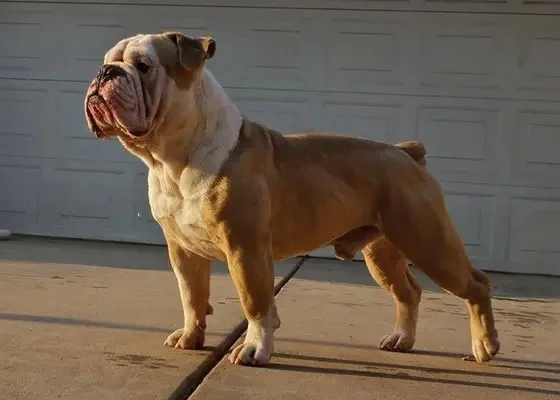
The Pacific Bulldog is a compact, athletic, powerfully built bulldog of smaller size, with heavy bone, a sturdy frame, a muscular body, a blocky head type and a smooth coat. It should give the impression of great strength for its size and exude confidence. It is outgoing and playful with a gentle demeanor, while still alert and aware of what is going on around it, making the Pacific Bulldog a great companion dog or family member.
Head type: The broad, heavy, square head of the Pacific Bulldog exemplifies the breed type; it is tall and large, with well-pronounced cheek muscles and a distinct stop. The stop should also be broad and deep and extend up the middle of the forehead, dividing the head vertically and traceable to the top of the skull…. The ears should be set from mid to high on the head, the front inner edge of each ear joining the outline of the skull at the top back corner of the skull, so as to place them as wide apart, as high and as far from the eyes as possible. The shape known as the “rose ear” is the most desirable. The rose ear folds inward at its lower back edge, the upper front edge curving outward and backward, showing part of the inside of the burr. A drop ear is also acceptable... Eye shape: almond or oval, set low in the head and well apart,
Neck: slightly arched, tapering from the shoulder to the back of the skull. Of compact to medium length, the neck should be thick and muscular with little or no loose skin.
Chest: The chest should be very broad, deep and full, with a well-sprung or rounded rib cage, but not exaggerated or so extreme that it hinders movement.
Back: The back is short to medium, with a slight slope or a gradual rise from the withers to the rump. The Pacific Bulldog should give the appearance of a square body, equal in length when measured from the point of the shoulder to the point of the rump and from the withers to the ground.
FOREQUARTERS: FOREQUARTERS: The shoulders should be muscular, very heavy, broad and well laid back. The front legs should be short, very sturdy, straight and muscular, set well apart, with well-developed calves giving an arched outline, but the leg bones should not be curved or bowed, nor the feet too close together. The elbows should be low, standing well out and loose from the body. The distance from the withers to the elbow equals the distance from the elbows to the soles of the feet. The feet should be of moderate size, compact and firm.
Hindquarters: The hindquarters should be strong and muscular and longer than the forequarters. The hocks should be slightly bent and well let down, so as to give length and strength from the loin to the hock. The lower leg should be short, straight and strong, with compact, firm toes and high knuckles. The angulation and width of the hindquarters should be in balance with those of the forequarters.
Feet: should be compact, rounded, firm and well arched. The pasterns should also be strong. Weak pasterns and/or splayed feet are disqualifying faults.
Tail: docked is preferred, but natural short and straight tails are accepted. Pacific tails should reach just below the hock, thick and straight. …faults or disqualification: impacted tails. Height 15 to 17 inches and weight 50 to 75 pounds for males and females.
Smooth and short, no more than 1/2 inch long.
Movement: It should have a balanced gait that drives from the rear and is complemented by reach, allowing the dog to cover ground with a sense of power. Dogs should single-track.
Colors and Patterns: Any color is acceptable except MERLE. Merle is a disqualification and is not present in the Pacific gene pool.