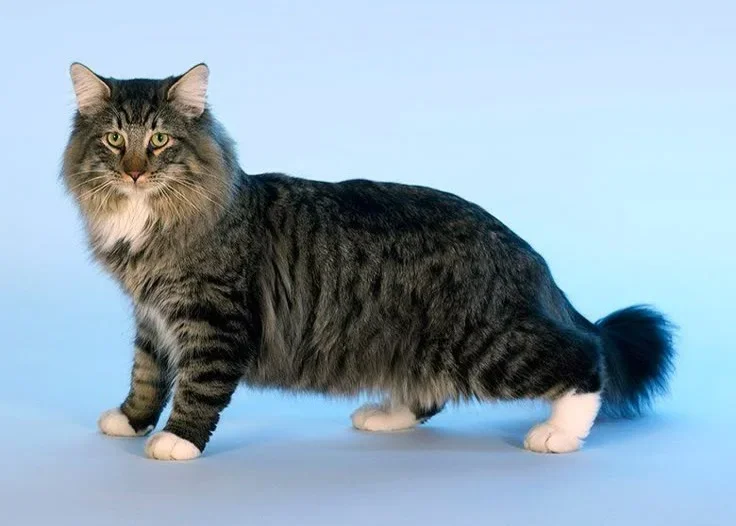
NORWEGIAN FOREST BREED STANDARD (NF)
POINT SCORE
HEAD: 40 points
- Shape ........................................ 8
- Ears .......................................... 8
- Eyes ............................................. 8
- Chin ........................................... 4
- Muzzle .......................................... 4
- Profile ............................................. 8
BODY: 35 points
- Torso ............................................ 7
- Legs ........................................... 7
- Tail ............................................ 7
- Boning ......................................... 7
- Musculature ..................................... 7
COAT AND COLOR: 25 points
- Length .................................. 5
- Texture ............................................ 20
CATEGORY: Traditional
DIVISION: All
COLORS: All
ALLOWABLE OUTCROSSES: None
HEAD
Shape
Triangular, with all sides equally long when measured:
- From the outer base of the ears to the chin
- Between the outer bases of the ears
Good height in profile. The forehead slopes back.
Eyes
Large, almond-shaped, set obliquely.
- Alert expression
- All colors allowed, except blue eyes or odd eyes
- Blue or odd eyes are allowed only in white cats or cats with white
Ears
Large, broad at the base, cupped forward as if listening.
- Slightly rounded tips, appearing pointed when there are lynx tips
- Tufts and furnishings beyond the outer edge are desirable
- The outer edge should follow the line of the head down to the chin
Muzzle
Follows the line of the triangular head, without excessive tapering or narrowing.
Profile
Long and straight, from the tip of the nose to the brow, without a break (no stop).
Neck
Muscular, medium length.
BODY
Torso
Medium to long, substantial.
Legs
In proportion to the body, with the hind legs higher than the front legs.
Feet
Large, rounded, well tufted.
Tail
Long and full.
- It should be at least as long as the body
Boning
Substantial.
Musculature
Strong and sturdy.
COAT / COLOR
Length
Semi-long.
Texture
A dense, woolly undercoat, covered by a smooth, water-resistant top coat of long, coarse, glossy hairs covering the back and sides.
A fully coated cat has:
- A full ruff
- Britches
Colors
All colors in the traditional category are recognized, including all variations with white.
- Any amount of white is allowed on any part of the body
OTHER
Balance
Muscular, well proportioned.
Condition
Considered appropriate by default.
Temperament
Intelligent and independent.
GENERAL DESCRIPTION
The Norwegian Forest developed over the centuries as a direct product of its natural environment.
Only the cats able to:
- Hunt
- Defend themselves
- Protect themselves from the weather
survived.
The survivors had:
- A water-resistant semi-long coat
- Proper body proportion
- Strength
- Intelligence
These features are reflected in the current standard.
It is a medium to large, strongly built cat, standing high on its legs, with a medium-long, rectangular body.
- Hind legs higher than the front legs
- Muscular
- Heavy boning
The head is triangular, with three equal sides.
The profile is long and straight, with a strong chin.
The eyes are large, expressive, almond-shaped and set obliquely.
The ears are large, open, in line with the shape of the head, and may have tufts and lynx tips.
The tail is long, full and carried high.
The coat is dense and rich, with a woolly undercoat and long, coarse, water-resistant guard hairs.
In summer, the coat is shorter.
- Tabbies: denser coat
- Solids, bicolors and tricolors: softer texture
The semi-long coat should not reach the length of a Persian's.
Full maturity only at 5 years.
Males: generally 5.5 to 7 kg or more.
Females: considerably smaller.
ALLOWANCES
- Lockets, buttons and spots allowed
- Seasonal coat variation
- Never penalize for being semi-long
- Judge mainly texture and quality
- Difference in size between the sexes
- Slow maturation
- Mature males may have a broader head
PENALIZE
- Small or delicate cats
- Round or square head
- Profile with a stop
- Round eyes
- Small ears or ears narrow at the base
- Short or weak legs
- Cow hocks
- Short tail
- Cobby or excessively long body
- Dry or silky coat
DISQUALIFICATION (DQ)
According to Article 16:
- Biting
- Fraud
- Males without two testicles
- Tail defects
- Polydactyly outside the standard
- Strabismus
- Blindness
- Incompatible size
- Chest abnormalities