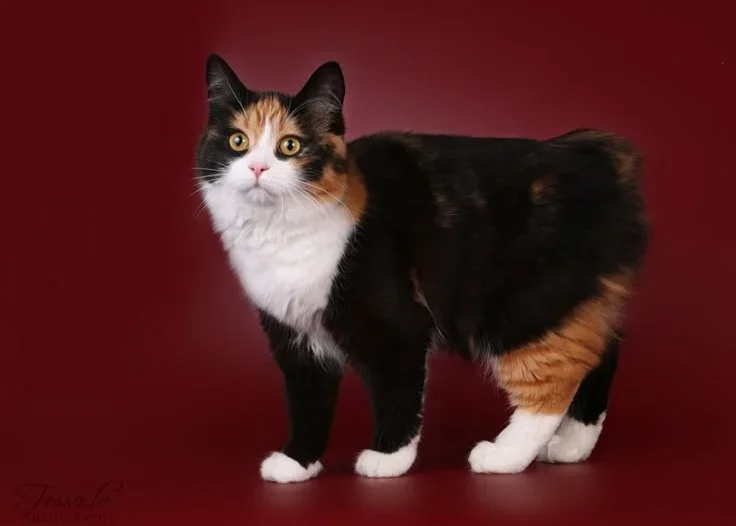
BREED STANDARD: MANX / CYMRIC (MX/CY)
DISTINGUISHING FEATURES: MANX AND CYMRIC
The Manx and the Cymric are essentially identical in every respect, differing only in coat length.
Cymric (CY)
- Medium to semi-long coat
- Silky texture (varies with color)
- Presence of “britches”
- Hair between the toes
- Full ear furnishings
Manx (MX)
- Short, well-padded coat
- Firmer texture (varies with color)
- Sparse ear furnishings
- No hair between the toes
- Classified as a shorthaired cat
POINT SCORE
HEAD: 35 points
- Shape ............................................. 6
- Ears .............................................. 6
- Eyes .................................................. 5
- Chin ................................................. 5
- Nose/Muzzle/Profile ............................. 8
- Neck ............................................... 5
BODY: 40 points
- Torso ............................................... 10
- Legs and Feet ....................................... 10
- Tail (absent) .................................. 8
- Boning/Musculature .......................... 12
COAT / COLOR / PATTERN: 15 points
- Coat Length .................... 5
- Texture ............................................... 5
- Pattern/Color .......................................... 5
OTHER: 10 points
- Balance ............................................. 5
- Condition ............................................. 5
CLASSIFICATION
CATEGORY
All.
DIVISION
All.
COLORS
All.
ALLOWABLE OUTCROSSES
None.
HEAD
Shape
Rounded, slightly longer than it is wide.
Medium size.
Prominent cheeks.
Stud jowls in adult males.
Ears
- Broad at the base
- Tapering to a rounded tip
- Medium size
- Set well apart
- Rear view resembles a cradle rocker
- Sparse hair in the Manx
- Full furnishings in the Cymric
Eyes
- Large
- Rounded
- Slightly angled
- Higher at the outer corner
- Color conforming to the coat
- Judged only when all other criteria are equal
Chin
Strong.
Muzzle
- Slightly longer than it is wide
- Definite muzzle break
- Rounded whisker pads
Profile
- Slight nose dip
- Moderately rounded forehead
Neck
Short and thick.
BODY
Torso
- Cobby type
- Medium size
- Deep flanks
- Short back
- Continuous arch from the shoulders to the rump
- Not excessively short
Legs
- Strong boning
- Well muscled
- Shorter front legs
- Longer, more muscular hind legs
- Should be straight when viewed from behind
Feet
- Rounded
- Medium size
- Hair between the toes suggested in the Cymric
Tail
Tailless appearance.
There is no penalty for a rise of bone or cartilage that does not stop the judge's hand from sliding.
Boning
Sturdy.
Musculature
Well developed.
COAT / COLOR
Length
Manx (MX):
- Short
- Double
- Not fully close-lying
Cymric (CY):
- Medium
- Double
Texture
Manx (MX):
- Soft
- Well padded
- Open outer coat
- Dense undercoat
- Seasonal variation allowed
Cymric (CY):
- Silky
- Well padded
- Thick undercoat
- Seasonal variations allowed
Pattern
All.
Color
All.
White buttons or lockets are allowed without penalty.
GENERAL DESCRIPTION
The ideal Manx/Cymric is a compact, muscular, medium-sized cat.
Main features:
- Rounded head
- Firm muzzle
- Prominent cheeks
- Short front legs
- Raised hindquarters
- Deep flanks
- An arched back
- Rounded rump
- Tailless appearance
These are slow-maturing breeds.
The following should be taken into account:
- Depth of flank
- Development of jowls
- Immaturity in young cats
The rump should be judged with the palm of the hand only.
ALLOWANCES
- Seasonal coat variations
- White buttons and lockets allowed
PENALIZE
- Eyes set horizontally
- Eyes set too close
- Elongated body
- Straight back
- Short hind legs
- Fine boning
- Bowed or knock-kneed legs
WITHHOLD AWARDS (WW)
- Evidence of illness
- Poor health
DISQUALIFICATION (DQ)
- Congenital deformities
- Weakness of the hind legs
- Inability to stand or walk
TEMPERAMENT
Must be gentle and not aggressive.
Defiant behavior results in disqualification.
GENERAL DISQUALIFICATIONS: ARTICLE 16
These include:
- Biting
- Fraud
- Cryptorchidism
- Unauthorized tail alterations
- Irregular polydactyly
- Strabismus
- Blindness
- Incompatible size
- Sternal abnormalities