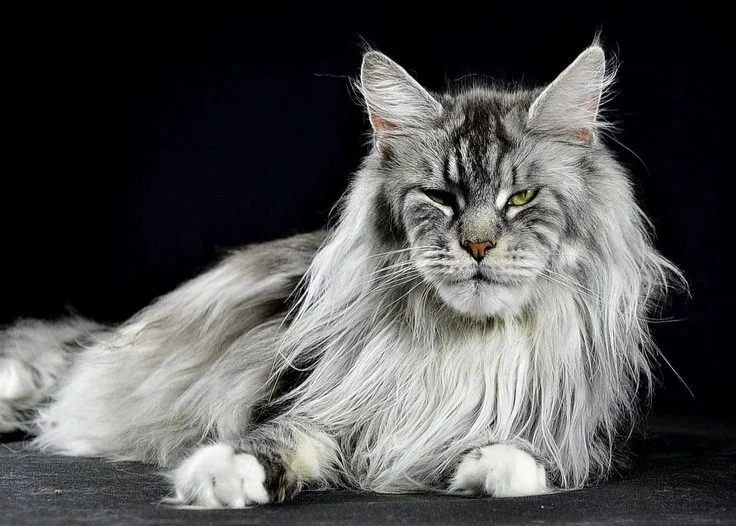
MAINE COON / MAINE COON POLYDACTYL BREED GROUP (MC/MCP)
GENERAL DESCRIPTION OF THE BREED
This group consists of the Maine Coon (MC) and the Maine Coon Polydactyl (MCP).
Overall balance and proportion are essential, and no feature should dominate the cat's appearance.
The Maine Coon comes from the northeastern United States and is considered native to the state of Maine.
It developed through natural selection, keeping only the fittest individuals.
Historically, it is a "working cat" breed, able to survive in harsh, forested and cold environments.
It is a large breed, with substantial boning, a broad chest and a long, rectangular, muscular body.
The tail is long and full.
The feet, whether polydactyl or normal, are large and well tufted.
Full maturity is reached between four and five years of age.
HISTORY
The Maine Coon is believed to descend from domestic cats brought by merchant ships and settlers from Western Europe.
Over time, they adapted to the harsh New England winters, developing:
- Hunting ability
- A muscular body
- A long, dense coat
- Tufts on the ears and feet
Polydactyl feet were common in the original population.
POINT SCORE
HEAD: 35 points
- Shape: 10
- Eyes: 6
- Ears: 6
- Muzzle / Chin: 6
- Profile: 6
- Neck: 1
BODY: 35 points
- Torso: 10
- Legs / Feet: 4
- Tail: 6
- Boning and Musculature: 15
COAT / COLOR / PATTERN: 20 points
- Length and Texture: 12
- Color / Pattern: 8
BALANCE: 10 points
CLASSIFICATION
- Category: Traditional only (Sepia, Mink and Pointed not allowed)
- Division: All
- Colors: Dominant black base only (B/-), including sex-linked red (Xo)
- Not allowed: Chocolate, lilac, cinnamon, fawn, caramel
- Allowable Outcrosses: None
HEAD STANDARD
Shape
Slightly longer than it is wide.
Seen from the front, a square muzzle below high, broad cheekbones, forming a modified wedge.
Eyes
Large and oval, almost round when open.
Slightly oblique.
About one eye-width apart.
Color: Green and/or gold.
Blue and odd eyes only in whites or with white.
Ears
Large, well furnished, broad at the base, tapering to lynx tips.
Taller than they are wide.
Outer base above eye level.
Slight outward tilt (between 11 and 1 o'clock).
Tufts extend beyond the outer edge.
Chin
Broad and deep, in line with the upper lip.
Muzzle
Well defined, square, with a clear transition to the cheekbones.
Profile
Gently curved forehead, transitioning to a slight concavity of the nose.
Smooth nose line, without bumps.
Vertical line from the nose to the chin.
Neck
Medium-long, thicker in mature males.
BODY STANDARD
Torso
Large, substantial, muscular and rectangular.
Broad, deep chest.
Even width from the shoulders to the hips.
Females smaller.
Legs
Substantial, medium length, straight.
Feet
All toes touch the ground.
Visible tufts between the toes.
- MC: Large, rounded
- MCP: Polydactyls allowed (up to 7 toes per foot)
Tail
As long as the body.
Broad at the base, tapering to the tip.
Long, flowing hair.
Boning and Musculature
Substantial.
Firm musculature, without flabbiness.
COAT / COLOR / PATTERN
Length
Uneven: short on the shoulders, growing longer along the back.
Obvious ruff, belly fur and britches.
Full tail.
Texture
"All-weather" coat, slightly silky.
Subtle undercoat.
Color and Pattern
Clear pattern according to the UCD.
Accepted: ticked, classic, spotted, mackerel, shaded, chinchilla.
White allowed on the feet.
ALLOWANCES
- Difference in size between the sexes
- More closely set ears in kittens
- Lower ear set in mature males
- Variations of polydactyly
- Ghost markings in young solids and smokes
PENALTIES
Head
Round, narrow or unmodified wedge
Eyes
Excessively round, almond-shaped, small, deep-set, too slanted
Ears
Small, rounded, without tufts
Chin
Narrow, pointed, receding or excessive
Muzzle
Narrow, triangular
Profile
Straight, stop, Roman nose
Neck
Too short or too long
Torso
Tubular, narrow, short, obese, excessively long
Legs
Cow hocks or bowed hocks
Tail
Too short
Feet
Not touching the ground, without tufts
Coat
Even, short, close-lying, without shag
Woolly or cottony texture
Color
Lockets, excessive spotting, spotted silvers
MOST COMMON COLORS
The Maine Coon comes in many colors, except pointed.
Most typical:
- Brown, red or silver tabby
- Classic, mackerel or ticked
- Solids: black, white, blue
WITHHOLD AWARDS (WW)
Head
Excessively heavy muzzle
Heavy brow
Eyes
Small or deep-set
Ears
Narrow base, parallel setting
DISQUALIFICATIONS (DQ)
- Colors not allowed
- Blue or odd eyes outside of white
- Fine boning
- Cobby body
- Tail defects
- Disproportionate tail
- Incompatible size
TEMPERAMENT AND GENERAL DISQUALIFICATIONS
Temperament must be gentle.
Aggression results in disqualification.
These include:
- Biting
- Fraud
- Males without two testicles
- Unauthorized absence of tail
- Polydactyly outside the standard
- Hidden defects
- Strabismus
- Blindness
- Incompatible size
- Chest deformity