BRIEF HISTORICAL SUMMARY
It probably descended, like all mastiff-type dogs, from the Molossians of Epirus and the Roman Empire, a relative of the Bulldog of Great Britain, the Alaunts of the Middle Ages, and the mastiffs and small mastiffs of France; the bulldog was the product of various crosses made by passionate breeders in the working-class districts of Paris in the 1880s. At that time it was the dog of the Halles market workers (butchers, coachmen), and it soon won over high society and the art world with its physique and especially its character. It then spread rapidly. The first breed club was founded in 1880 in Paris. The first registration dates from 1885, and the first standard was established in 1898, the year in which the Central Canine Society (French Kennel Club) recognized the French Bulldog as a breed. The first dog of this breed was shown in early 1887.
GENERAL APPEARANCE
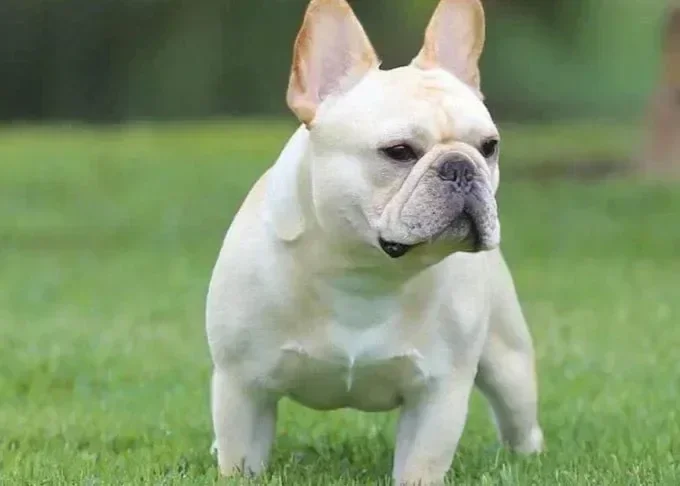
The type is that of a small molosser. A powerful dog for its small size, short-bodied, thick-set, compact in all its proportions, short-coated, with a flat nose, erect ears and a naturally short tail. It should look like an active, intelligent, very muscular dog of compact build with solid bone. No point is exaggerated in relation to the others, which could destroy the overall harmony or give the dog a deformed appearance in type or movement.
IMPORTANT PROPORTIONS
The length of the body, measured from the point of the shoulder to the point of the buttock, is slightly greater than the height at the withers. The length of the muzzle is about 1/6 of the total length of the head.
BEHAVIOR / TEMPERAMENT
A sociable, cheerful, playful, possessive and active companion dog.
HEAD
It should be strong, broad and square; the skin covering it forms symmetrical folds and wrinkles, without excess.
CRANIAL REGION
Skull: Broad, almost flat from ear to ear, with a domed forehead. Prominent brow ridges, separated by a pronounced furrow between the eyes. The furrow does not extend onto the forehead. External occipital crest very poorly developed. Stop: Pronounced.
FACIAL REGION
The head of the French Bulldog is characterized by a shortening of the maxillo-nasal region, as well as by a slight to moderate backward tilt of the nose. The nose is slightly turned up.
Nose: Black, broad, flat, with well-opened, symmetrical nostrils, angled obliquely backward. The slope of the nostrils and the upturned nose should allow normal nasal breathing.
Muzzle: Very short, broad, with concentric, symmetrical folds.
Lips: Thick, a little loose and black. The upper lip meets the lower lip at its midpoint, completely covering the teeth. The profile of the upper lip is descending and rounded. The tongue should never be visible when the dog is at rest.
Jaws/Teeth: Jaws broad and powerful. The lower jaw projects in front of the upper jaw and curves upward. The lower incisor arch is rounded. The jaws must not show any lateral deviation or twisting. The gap between the incisor arches is not strictly defined; the essential condition is that the upper and lower lips close tightly, completely covering the teeth. The lower incisors are in front of the upper incisors. Incisors and canines sufficiently developed. Full dentition is desired.
Cheeks: Well developed.
Eyes: Clearly visible, with an alert expression, set low, well away from the nose and ears, dark in color, fairly large, well rounded and showing no trace of white (sclera) when the dog is looking straight ahead. The rims of the eyelids should be black.
Ears: Medium-sized, broad at the base and rounded at the tip. Set high on the head, not too close together, carried erect. The opening faces forward. The skin should be fine and soft to the touch.
NECK
Short, powerful, slightly arched, without dewlap, widening toward the shoulders.
BODY
Topline: Rising gradually, but not excessively, from the withers
to the loin. This conformation, called the carp back (roach back), is a characteristic of the breed.
Back: Broad and muscular, solid and without slackness.
Loin: Short, broad and arched.
Croup: Well sloped.
Chest: Cylindrical and well let down (slightly below the elbows), ribs very well sprung, described as “barrel-shaped”. Chest wide open, fitting into a square when viewed from the front.
Underline and belly: Tucked up, but without excessive tuck-up.
TAIL
Naturally short, ideally just long enough to cover the anus, set low, fairly straight, thick at the base and tapering toward the tip. A twisted, knotted, kinked or relatively long tail that does not reach past the point of the hock is accepted. It is carried low, even in action, and should not rise above the horizontal.
FOREQUARTERS
General appearance: Legs correctly placed when viewed in profile and from the front.
Shoulder blades: Should be well sloped.
Upper arms: Short, thick, muscular, slightly curved.
Elbows: Close to the body, without slackness.
Forearms: Short, straight and muscular.
Wrists: Solid and short.
Pasterns: Short and slightly sloping when viewed in profile.
Feet: Round, compact, small, known as “cat feet”, turned slightly outward. The toes are tight, the nails short, thick and black.
HINDQUARTERS
General appearance: The hind legs are strong and muscular, a little longer than the forelegs, thus raising the rear. The legs are straight when viewed in profile and from behind.
Thighs: Muscular and firm.
Hocks: Well let down, neither too angulated nor too straight.
Tarsus: Solid.
Rear pasterns: Short.
Feet: Round, very compact, turning neither in nor
out.
GAIT / MOVEMENT
The legs move parallel to the median plane of the body, viewed both from the front and in profile. The movement is free, powerful and regular.
SKIN
Without slackness.
COAT
Hair: Short, close, glossy and soft, without undercoat.
Color: Fawn, brindle or not, with or without white markings. Coats without white markings.
Brindle: Fawn coat with moderate transverse stripes of dark brindle giving a “tiger” appearance; a heavily brindled coat should not hide the fawn background. A black mask must be present. Limited white markings may or may not be present.
Fawn: Solid coat, from light fawn to dark fawn, sometimes with lighter shading on the underparts, with or without a black mask, the masked coat being preferred. Limited white markings may or may not be present.
Coats with white markings: Brindle with a moderate or large amount of white markings, called “quail”, the white ideally distributed over the whole dog.
Some spots on the skin are tolerated. Fawn with a moderate or large amount of white markings, called “fawn and white”, the white ideally distributed over the whole dog. Some spots on the skin are tolerated. For all coats, the nose is black, never brown or blue. Fully white dogs (with the white completely invasive), as long as the nose and eyelid rims are black, are accepted, but not
sought after because of the risks associated with deafness.
SIZE / WEIGHT
Height at the withers: Males: 27 to 35 cm; Females: 24 to 32 cm, with a tolerance
of 1 cm more or less.
Weight: Males: 9 to 14 kg; Females: 8 to 13 kg. A tolerance of 500 g above
the upper limit is accepted if the dog is very typical.
FAULTS
Any departure from the foregoing points should be considered a fault, and the seriousness with which the fault is regarded should be in exact proportion to its degree and its effect upon the health and welfare of the dog.
Heavily speckled “quail” color.
Heavily speckled fawn and white color.
For fawn dogs, a very pronounced dorsal stripe extending along the back.
“White socks” on brindle and fawn dogs.
Light nails.
SERIOUS FAULTS
“Hypertype”, exaggeration of the breed's own characteristics.
Muzzle too long or too short.
Tongue visible with the mouth closed.
Light eye (bird-of-prey eye).
Level topline from the withers to the loin.
Excessive depigmentation of the lips, nose and eyelid rims,
which must never be completely unpigmented.
Level bite.
DISQUALIFYING FAULTS
Aggressive or overly shy.
Any dog clearly showing physical or behavioral abnormalities shall be disqualified.
Lack of type: insufficient breed characteristics, so that the dog as a whole does not sufficiently resemble other members of its breed.
Completely closed nostrils.
Lateral deviation or twisting of the jaw leaving the tongue permanently visible.
Dogs whose lower incisors close behind the upper incisors.
Dogs with canines (fangs) permanently visible even with the mouth closed.
Heterochromatic eyes.
Nose any color other than black.
Ears not carried erect.
Taillessness and ingrown tail.
Dewclaws on the hind legs.
Inverted hock (“cow hock”).
Long, harsh or woolly coat
Color not as described in the standard, including black, black with
fawn markings and all dilutions of black, with or without white markings.
Size and weight outside the accepted limits.
Breathing difficulty
Deafness.
NOTES
Male animals should have two apparently normal testicles fully descended into the scrotum.
Only functionally and clinically healthy dogs with breed-typical conformation should be used for breeding.