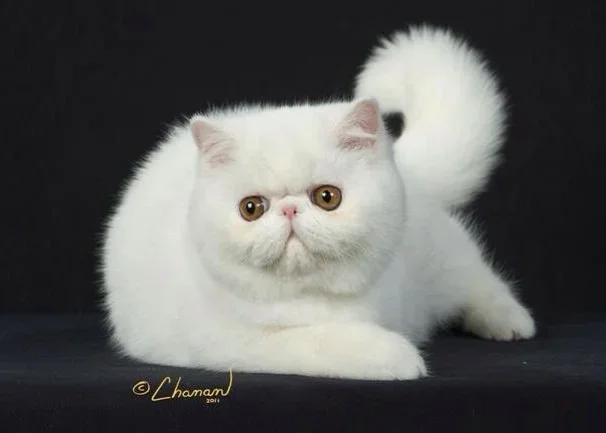
PERSIAN / HIMALAYAN / EXOTIC SHORTHAIR BREED GROUP (PS/HI/ES)
GENERAL DESCRIPTION OF THE BREED
This breed group consists of the Persian (PS), the Himalayan (HI) and the Exotic Shorthair (ES).
All share the same head and body type; the features that distinguish the breeds are coat and coloring.
- PS and HI: long, flowing coat.
- ES: short, distinctive, plush, dense coat standing away from the body.
The origin of the PS is lost in time. The HI is a man-made breed developed to produce the "pointed" version of the PS. The ES was developed to look more like a "teddy bear", keeping the facial features of the PS/HI, but with a shorter, denser and plusher coat, longer than that of other shorthaired breeds, yet short enough not to flow.
(PS/ES) All traditional colors and (HI) all pointed colors are accepted.
The only genotypes allowed at the C locus are: CC, Ccs and cscs.
POINT SCORE
HEAD: 40 points
- Shape: 6
- Ears: 5
- Eyes: 7
- Chin / Jaw and Bite: 10
- Nose: 7
- Profile: 5
BODY: 35 points
- Torso: 10
- Feet and Legs: 10
- Tail: 5
- Boning / Musculature: 10
COAT / COLOR / PATTERN: 25 points
- Length / Texture: 15
- Color / Pattern: 10
CLASSIFICATION
- Categories:
- PS: Traditional
- HI: Pointed
- ES: Traditional and Pointed
- Divisions: All
- Colors: All
- Allowable Outcrosses: None
HEAD STANDARD
Shape
Round, broad, smooth, domed, with great breadth.
It should be medium to large, symmetrical and balanced.
Broad, powerful jaws, with correct tooth alignment.
Broad, prominent cheeks.
Sweet overall expression.
Ears
Small, with rounded tips, base not excessively open.
Set well apart, blending into the contour of the head.
Eyes
Large, round and full.
Set level and well apart, giving a sweet expression.
Eye color is as important as size and shape.
PS/ES: Deep, brilliant color is preferred, according to the coat.
Copper eyes are preferred in all colors, except in silvers and goldens, where green eyes are preferred.
Blue or odd eyes only in whites or with white.
HI and pointed ES: Medium blue is acceptable.
Chin
Strong, full, well developed, in harmony with the face.
Nose
Almost as wide as it is long, with fully formed nose leather and open nostrils.
Short, broad, full muzzle.
Profile
Short, snub nose, with a defined break directly between the eyes.
The break should be above the lower edge of the eyes and no higher than the center of the eyes.
Forehead, nose and chin should appear aligned, or very slightly rounded, in keeping with the head.
Neck
Short, thick and well muscled.
BODY STANDARD
Torso
Cobby, firm, well rounded in the abdomen, in proportion.
Medium to large size.
Short, level back.
Deep chest.
Equally massive across the shoulders and rump, with a short, rounded abdomen and well-sprung ribs.
Legs
Large, well-developed bones, firm musculature.
Front view: short and straight, starting from the broad chest, reinforcing the sturdy look, without a "bulldog appearance".
Rear view: straight.
Feet
Round and large.
(PS/HI) They should have tufts.
Tail
Short and straight, in proportion to the body.
Boning
Heavy, sturdy and in proportion.
Musculature
Firm and well developed, without excess fat.
COAT / COLOR / PATTERN
Length
(PS/HI) Long all over the body, full of life, with a dense undercoat giving volume.
The ruff should be immense.
(ES) Short, but slightly longer than that of other shorthairs.
Soft, dense, plush, standing away from the body.
In the homozygous ES, the coat is shorter and therefore does not stand away from the body as much; a more "sculpted" look and a less furnished tail.
Color
(PS/ES) According to the TICA color descriptions.
(HI and pointed ES) A light body is preferred, with subtle shading allowed.
There should be a definite contrast between body and points.
The points (ears, legs, feet, tail and mask) should show the basic color.
OTHER CRITERIA
Condition / Balance
Should reflect excellent health and sturdy power, with good musculature, well muscled but not fat.
All parts of the body should be in proportion.
GENERAL DESCRIPTION (IDEAL)
The ideal PS/HI/ES is a strong cat with excellent boning and musculature, well balanced, conveying sturdy power.
Round face with a sweet, pleasant expression, large, round and expressive eyes.
Physically and temperamentally balanced, gentle and easy to handle.
LOCKETS
Withhold for lockets and buttons.
ALLOWANCES
- Females generally smaller than males of the same age, keeping proportion and balance.
Eyes:
In kittens, the color may look cloudy in orange-eyed cats.
Blue (HI and pointed ES) and green (silvers) develop from the center outward and should be fully developed in adulthood.
Coat:
Seasonal variations in length and volume are acceptable; a shorter coat in summer is entirely acceptable in well-presented PS/HI.
(HI and pointed ES) allow for slightly shaded areas in adults.
PENALIZE
Head
Long or narrow head.
Irregularities in the skull (bumps/dips) according to severity.
Long Roman nose.
Thin muzzle.
Slightly undershot or overshot bite.
Bite deformities (misaligned canines and missing canines) in whole adults.
Extreme depression of the stop.
Small nostrils.
Asymmetry (crooked or off-center nose/mouth) according to severity.
Large, pointed ears, tilted outward or set too close.
Small or closely set eyes.
Green halo near the pupil in kittens and adults.
(PS/ES) Pale/weak eye color.
(HI and pointed ES) Pale or grayish eyes.
Spots of other colors in the iris.
Body
Narrow chest or long back.
Poor muscle tone.
Flat flanks.
Coat
Coat in poor condition.
(HI and pointed ES) Penalize very heavy shading on the body:
seasonal shading can be judged by the color at the roots; if the coat is fully colored down to the roots, it should be penalized.
Most obvious in dark pointeds.
WITHHOLD AWARDS (WW)
- Audible or heavy breathing
- Pinched or very narrow nostrils
- Very small or malformed nose leather
- General lack of merit
- Poor general condition
- Eye color other than blue in HI and pointed ES
DISQUALIFICATION (DQ)
According to Rule 216.12.10: inability to breathe normally with the mouth closed must be disqualified.
Also DQ:
- Kinked tail
- Malocclusion or extremely asymmetrical face
- Crossed, slanted or poorly focused eyes
- Severe undershot or overshot jaw
TEMPERAMENT AND GENERAL DISQUALIFICATIONS
Temperament must be gentle.
Any sign of aggression results in disqualification.
Mandatory disqualifications include:
- Biting
- Fraud
- Males without two testicles
- Unauthorized absence of tail
- Unauthorized polydactyly
- Tail defects (visible or not, where required)
- Strabismus (where required)
- Total blindness
- Incompatible size
- Chest deformity