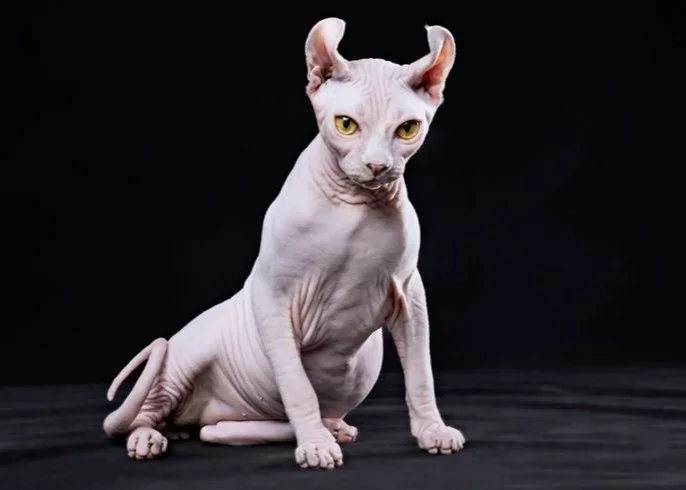
ELF BREED
GENERAL DESCRIPTION OF THE BREED
The Elf breed was established by a group of breeders with the goal of developing a unique cat that would be both hairless and have curled ears.
The Elf is visually striking because of these two features.
The breed originated from crossing the Sphynx with the American Curl.
Both the Sphynx and the American Curl may be crossed with domestic cats of unrecognized breeds (registered or not), as may the Elves themselves.
GENETIC BASIS OF THE BREED
Each parent breed contributes specific features:
American Curl
Contributes the curled-ear gene, which is a dominant genetic mutation.
For a kitten to be born with curled ears, at least one of the parents must have this trait.
Sphynx
Contributes the recessive hairless gene.
Two coated parents can produce a hairless kitten, as long as both carry the gene.
HEAD STANDARD
Ideally, the Elf's head should be slightly longer than it is wide, with:
- Prominent cheekbones
- A well-defined whisker break
- Obvious whisker pads
The skull should be slightly rounded, with a flat frontal plane in front of the ears.
Eyes
Characteristic walnut shape:
- Rounded lower part
- Oval upper part
They should be at least one eye-width apart.
Set with a slight slant between the base of the ear and the tip of the nose.
Eye colors:
- May range from gold to green
- In pointed cats, they must be blue
EAR STANDARD
The desired curl should be between:
- Minimum: 90°
- Maximum: 180°
The ears should be:
- Broad at the base
- Open
- Curled back in a smooth arc, visible from any angle
They should not curl so far that the tip touches the back of the ear.
The curl is one of the two most important features of the breed and one of the main factors that set it apart from any other recognized breed.
COAT, SKIN, COLOR AND PATTERN
Color and Pattern
Elves may come in any genetically possible color or pattern.
Several colors in the same litter are common.
Coat
Some Elves may have hair, although the goal of the breeding program is to produce hairless cats.
The texture may range between:
- A soft suede feel
- Smooth skin like a baby's
Hair is acceptable on the:
- Feet
- Ears
- Nose
- Tail
- Scrotum
Fine down on the body is also acceptable, as long as it does not compromise the hairless appearance.
Elf cats with an obvious coat are classified as non-standard Elves.
BODY STANDARD
The Elf is a medium to large cat, with:
- Sturdy musculature
- Firm boning
It should have a "full belly" look, a trait inherited from the Sphynx.
The body should convey strength, solidity and balance.
GENERAL DESCRIPTION (IDEAL)
The ideal Elf is a balanced, muscular, hairless cat (or with minimal down), with harmonious curled ears and a striking expression.
It has an extremely affectionate, sociable personality and depends on human interaction.
It is a cat that likes to be the center of attention, taking an active part in family life.
It is not suited to living outdoors.
At present, it is a rare breed.
BREEDING AND GENETIC CONSIDERATIONS
Because it inherits two distinct genetic mutations (hairlessness and curled ears), it may take two or more generations before a completely hairless Elf is born.
This makes the breeding program technically complex and selective.
IMPORTANT NOTES
- Developing breed
- Requires careful skin care
- Extremely dependent on human contact
- Breeding requires rigorous genetic planning
- Main priorities: curled ears + hairless appearance