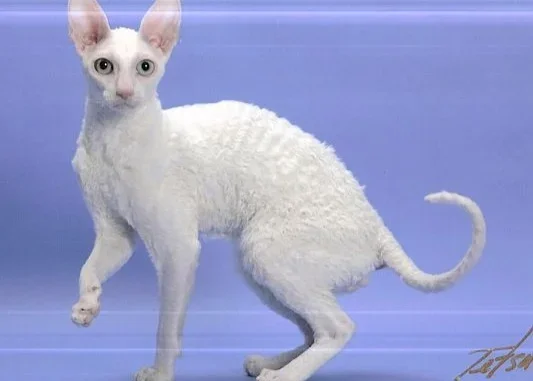
BREED STANDARD: CORNISH REX (CR)
POINT SCORE
HEAD: 29 points
- Shape ............................................. 5
- Eyes ................................................ 5
- Ears .............................................. 6
- Chin ................................................ 3
- Muzzle ............................................... 4
- Profile .................................................. 4
- Neck .............................................. 2
BODY: 29 points
- Torso ............................................... 8
- Feet .................................................... 2
- Tail .................................................. 4
- Boning ............................................. 8
- Musculature ........................................ 7
COAT / COLOR / PATTERN: 32 points
- Length ...................................... 4
- Texture ............................................... 26
- Color .................................................... 2
OTHER: 10 points
- Balance ............................................. 5
- Condition ............................................. 5
CLASSIFICATION
CATEGORIES
All.
DIVISIONS
All.
COLORS
All.
ALLOWABLE OUTCROSSES
- American Shorthair
- British Shorthair
- European Shorthair
HEAD
Shape
Medium, egg-shaped, with a pronounced occiput accentuating the oval shape.
Longer than it is wide, but not excessively elongated.
Eyes
- Medium size
- Oval shape
- Set one eye-width apart
- Slightly slanted upward
- Color conforming to the coat
Ears
- Large
- Deep conical shape with a modified tip
- Set high, but not excessively so (avoiding "donkey ears")
- Usually hairless on the outside
Chin
Straight line from the nose to the chin, neither receding nor overly protruding, in harmony with the oval shape.
Muzzle
Well-defined break.
Profile
Roman, with a high, prominent nose bridge.
It may show a slight change of direction at eye level, separating two convex curves or forming one continuous curve.
Neck
Slender, medium length.
BODY
Shape
- Long
- Full, deep rib cage
- The torso follows the curve of the spine, forming a "tuck-up" (drawn-up abdomen)
- Rounded hips, proportionally heavier
- Small to medium size
- Males proportionally larger
Boning
Very fine.
Musculature
Firm and muscular.
Tail
- Long, slender, slightly tapering
- Covered with fine, dense hair
- Waves preferred
- Partial baldness on top is not penalized
- Abnormalities should not be confused with a slight natural curve of the last vertebra
Feet
Small, oval.
COAT / COLOR / PATTERN
Length
Short.
Texture
Fine, soft hair with well-defined ridges, forming a wavy appearance.
Velvet-like on the head and legs.
Color
Recognized in all colors.
OTHER
Condition
- Firm, muscular body
- No signs of obesity or emaciation
- Firm abdomen
- Bright eyes
- Coat with a healthy sheen
- Overall appearance of vitality
Balance
A distinctive combination of fine boning and firm musculature, with all parts in proportion.
Alert, athletic appearance.
GENERAL DESCRIPTION
The Cornish Rex is a fine-boned cat with a curly coat that stands high on its legs.
It has:
- An arched back
- A deep rib cage
- A drawn-up abdomen ("tuck-up"), reminiscent of a greyhound
- A firm, muscular body that is warm to the touch
The quality, texture and wave of the coat, as well as the distinctive body type, are of primary importance.
ALLOWANCES
- White lockets or buttons allowed.
PENALIZE
- Lack of a defined muzzle break
- Excessively wedge-shaped head
- Extensive hairless areas on the body, except the ears and tail
WITHHOLD AWARDS (WW)
- Presence of coarse guard hairs
TEMPERAMENT
Temperament must be gentle.
Any sign of defiance results in disqualification.
DISQUALIFICATIONS (DQ)
According to Article 16, including:
- Biting
- Attempted fraud
- Cryptorchidism
- Partial or total absence of the tail
- Polydactyly outside the standard
- Strabismus (where applicable)
- Total blindness
- Size incompatible with the breed
- Sternal abnormalities