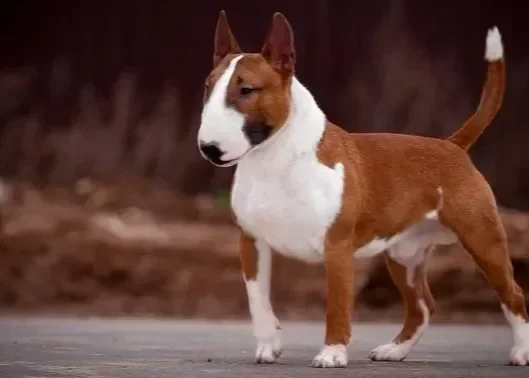
BRIEF HISTORICAL SUMMARY
It was a certain James Hinks who first standardized the breed type around 1850, selecting for the egg-shaped head. The breed was first shown in its present form in Birmingham in 1862. The Bull Terrier Club was formed in 1887. An interesting thing about the breed is that the standard deliberately states: “there are no weight or height limits, but the dog should give the impression of maximum substance for its size, consistent with quality and sex. The dog should at all times be balanced”.
Smaller Bull Terriers were known from the early 19th century, but lost popularity before the First World War and were removed from the Kennel Club breed register in 1918. In 1938, a revival of the breed was led by Colonel Richard Glyn and a group of enthusiastic friends who founded the “Miniature Bull Terrier Club”. The standard is the same as the Bull Terrier's, except for the height limit.
GENERAL APPEARANCE
Strongly built, muscular, well balanced and active, with a keen, determined and intelligent expression. A unique feature is its downfaced, egg-shaped head. Regardless of size, males should look masculine and females feminine.
BEHAVIOR / TEMPERAMENT
Courageous, full of spirit, with a fun-loving, kind attitude. Of even temperament and amenable to discipline.
Although obstinate, it is particularly good with people.
HEAD
Long, strong and deep right to the end of the muzzle, but never coarse. Viewed from the front, it is egg-shaped and completely filled; its surface is free from hollows
or indentations. The profile curves gently downward from the top of the skull to the tip of the nose.
CRANIAL REGION
Skull: The top of the skull is almost flat from ear to ear.
FACIAL REGION
Nose: Should be black. Bent downward at the tip. Nostrils well developed.
Lips: Clean and tight.
Jaws / Teeth: Lower jaw deep and strong. Teeth sound, clean, strong, of good size, regular, with a perfect, regular and complete scissor bite, i.e. the upper incisors closely overlap the lower incisors and are set square to the jaws.
Eyes: Appearing narrow and triangular, obliquely placed; black or as dark brown as possible, so as to appear almost black, and with a
piercing glint. The distance from the eyes to the tip of the nose should be noticeably greater than from the eyes to the top of the skull. Blue or partly blue eyes are undesirable.
Ears: Small, thin and placed close together. The dog should be able to hold them stiffly erect, pointing straight upward.
NECK
Very muscular, long, arched, tapering from the shoulders to the head and free from loose skin.
BODY
Well rounded, with marked spring of rib and great depth from withers to brisket, so that the brisket is nearer the ground.
Back: Short, strong, with the topline behind the withers level, arching slightly over the loin.
Loin: Broad and well muscled.
Chest: Broad when viewed from the front.
Underline and belly: From the brisket to the belly, it forms a graceful upward curve.
TAIL
Short, set low and carried horizontally. Thick at the root, tapering to a fine point.
FOREQUARTERS
General appearance: The dog should stand solidly on its legs, which should be perfectly parallel. In mature dogs, the length of the forelegs should be approximately equal to the depth of the chest.
Shoulders: Strong and muscular without being loaded. Shoulder blades wide, flat and held closely to the chest wall, with a very pronounced backward slope of the front edge from bottom to top, forming almost a right angle with the upper arm.
Elbows: Held straight and strong.
Forearms: Should have strong, round bone of good quality.
Pasterns: Upright.
Feet: Round and compact, with well-arched toes.
HINDQUARTERS
General appearance: Legs parallel when viewed from behind.
Thighs: Muscular.
Stifles: Well bent.
Second thighs: Well developed.
Hocks: Well angulated.
Rear pasterns: Short, strong bones.
Feet: Round and compact, with well-arched toes.
GAIT / MOVEMENT
When moving, it appears well knit, covering the ground smoothly with free, easy strides and a typical jaunty air. At the trot, the movement is parallel, front and rear, only converging toward the center line as
speed increases. The forelegs show good reach and the hind legs move smoothly at the hips, with great drive from the flexing of the stifles and hocks.
SKIN
Fitting tightly.
COAT
Hair: Short, flat, even, harsh to the touch and with a fine gloss. A soft undercoat may be present in winter.
COLOR
In whites, pure white coat. Skin pigmentation and markings on the head should not be penalized. In coloreds, color predominates over white.
All other things being equal, brindle is preferred. Black brindle, red, fawn and tricolor are acceptable. Small markings on a white coat are permissible. Blue and liver are highly undesirable.
SIZE / WEIGHT
There are no weight or height limits, but the dog should give the
impression of maximum substance for its size, consistent with quality and sex.
FAULTS
Any departure from the foregoing points should be considered a fault, and the seriousness with which the fault is regarded should be in exact proportion to its degree and its effect upon the health and welfare of the dog.
DISQUALIFYING FAULTS
Aggressive or overly shy.
Any dog clearly showing physical or behavioral abnormalities
shall be disqualified.
NOTES
Male animals should have two apparently normal testicles fully descended into the scrotum.
Only functionally and clinically healthy dogs with breed-typical conformation should be used for breeding. The latest amendments are in bold.