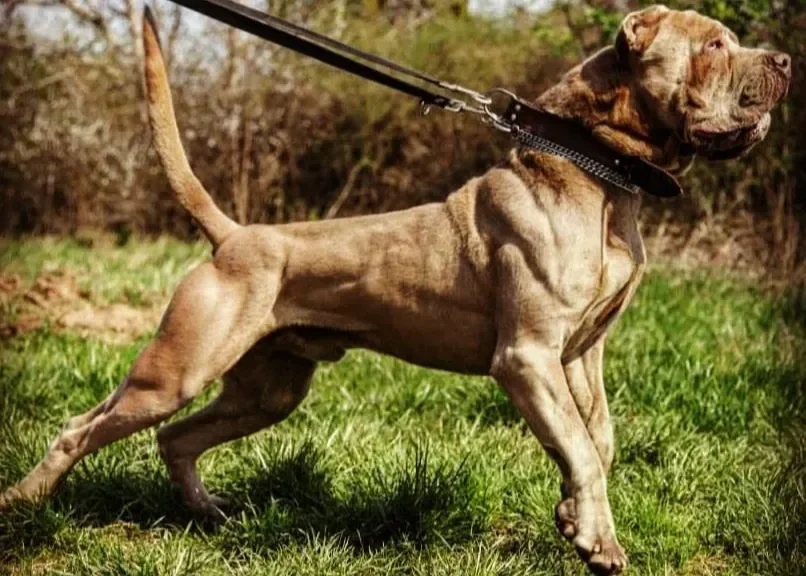
HISTORY OF THE BANDOGGE
It was later in its history that the dog became known as the “Bandog” or “Bandogge”, since, of course, the dog was not known by any other name than: Killer Hound, War dogs, Molossus, Mastiff, Mastyue, Villaticus, Cathenarius, Bulldogs, Dogue the Force Race and Engelsen Doguen. The extraordinary courage of these dogs is hard to believe. Bred from a long line of fighting ancestors, a dog came to have such ferocity and courage that it seemed almost insensitive to pain. In the book by Mr. Edgar Farman (1900s), an expert on Bulldog history, he wrote:
”The first mention of the word “Bulldog” in literature, around the year 1500, was in the other, older spelling of the word, which is “bandog” and “bandogge”.
Mr. Barret Fowler, another author of Bulldog books, wrote in 1929: “As to supposing that the Bandog was the ancestor of the Bulldog… Personally, I think not. It is certain that the two dogs were close relatives, but the Bulldog existed as “the Bulldog” at the same time that the Bandog was a recognized breed. Moreover, these dogs differ in several essential characteristics.
The Bandog had a rough coat, usually yellowish or sandy gray in color. It also had a keen sense of smell; the Bandog was a man-made breed produced by crossing the Mastiff with the Fox-Hound, which, of course, explains its scenting powers. A Bulldog cross was probably used to produce a Bandog because it was common to use a Bulldog to improve other breeds”.
It is impossible to say how the Bandogge originated; most writers are of the opinion that all dogs descend from the wolf (ancient dogs), but the development of the Bandogge still remains a mystery. When we look at the records, it seems likely that the Old Bulldog must have been crossed with the Mastiff and selected for bull baiting. American Bandog Mastiffs or American Bandogge Mastiffs were probably selected from bull-baiting dogs and guardian Mastiffs, or from a cross of both of the war dogs used in the Crusades (medieval battles that took place from the 11th to the 13th centuries).
William Harrison, in his Description of England (1586), mentions the word “Bandogge” because “many of them are tied up with chains and strong bonds during the day, for doing harm abroad; it is a huge dog, stubborn, ugly, eager, burdensome of body, terrible and frightful to behold, and often fiercer and fouler than any Arcadian or Corsican cur.
Dr. Caius (1576) states that, among other traits, the “Mastiff or Bandogge serves against the fox and the badger, to drive wild and tame swine out of meadows and pastures, and to bite and take the bull by the ear when occasion so requires”.
DESCRIPTION OF THE MODERN BREED
The component breeds used to make the old bandog are not completely known. Most agree that Bull x Molosser crosses were used. The dogs were bred only from lines with temperament, phenotype and working ability. The American Bandog Mastiff or American Bandogge Mastiff is a sturdy, heavy-boned, muscular dog, intimidating to look at and fierce when provoked.
A powerful dog able to stop man and beast; there is no doubt that the dog played this role in the old world. With a broad skull, a short to long muzzle depending on the Bandog strain, a powerful bite, broad shoulders and a powerful chest with hindquarters to match, the Bandog has lived on through the centuries to the present day.
Still holding to the traditional cross, many have bred superb varieties.
The Bandog still fulfills its traditional role and does well in personal protection work, sport work and property guarding, as well as fighting in countries that have legal forms of dog fighting.
This is the American Bandog Mastiff or American Bandogge Mastiff in all its glory.
APPEARANCE
Height and weight vary among lines made up of different component breeds. We provide several Bandog appearance categories based on known component breeds used in creating a line of American Bandog Mastiffs or American Bandogge Mastiffs. This is not a giant among dogs, but it is a massive, very muscular animal, well balanced overall and showing great strength. It should be alert, with a symmetrical, well-proportioned body. The dog should look like a demanding athlete: compact, muscular and proud.
Foundation Breeding: “A working cross, bred to perform one or more tasks, predominantly from Mastiff / Bull breed crosses”.
The first group, at least 25% to 50% of: American Pit Bull Terrier APBT, American Staffordshire Terrier AST, Staffordshire Bull Terrier SBT, Staffordshire Terrier ST.
The second group, at least 25% to 50% of: AKC Mastiff, Boerboel, Bullmastiff, Fila Brasileiro, Neapolitan Mastiff, Rottweiler and Tosa.
The third group should be less than 25% of: American Bulldog, Dogo Argentino, Dogue de Bordeaux, Great Dane, Olde English Bulldog and Bulldog Campeiro.
The fourth group should be less than 12.5% of: Boxer, Cane Corso and Presa Canario.
NOTE: To be called a Bandog, the cross required F3 on at least one side. After F3, introducing purebred crosses should be avoided. If necessary, the preference is to cross with a Bandog from another kennel (at least F3) to add “vigor” without losing working ability and to avoid F1 segregation.
SIZE and WEIGHT - The size will depend on the dog's genetics and the work it is intended for. Males: height 20 to 30 inches, weight 70-125 pounds; females: height 19-25 inches, weight 70-120 pounds
DRIVES: Guardian, Hunting, “Farm Work” and Extreme Sport together; any hard-working drive is also required.
SPECIAL TRAIT: A companion to the family owner, with intelligence, loyalty and devotion to its master, and sometimes stubborn.
TEMPERAMENT: A fearless opponent to anyone who threatens its master or property. Friendly with other animals and dogs. It shows a definite preference for its family, including children, but it is not a dog that gets along well with a visitor in the home if its owner is not there.
DISPOSITION: To protect its master from any danger, even giving its own life to protect them.
BODY: Much more typical of the compact “Mastiffs” with the build of a giant Pit Bull, it also keeps much of the agility passed on to it by the Pit Bull.
COLOR · “A good dog can't be a bad color”. Different mixed colors. The most common colors are: yellowish or sandy gray, any brindle, black, golden fawn, fawn and red. Other colors are also allowed. Red nose and black nose.
COAT: Short, close and medium-fine.
EARS: Small to large size preferred, and hanging.
NECK: Very strong, muscular and sturdy.
EYES: Preferably dark, but they may have some relation to coat color.
FAULTS: Not working, not working successfully, producing genetic problems in puppies, a deficient immune system, being affected by hip and elbow dysplasia. A head small in proportion to the body. An excessively undershot jaw, to avoid difficulty eating and some related diseases.