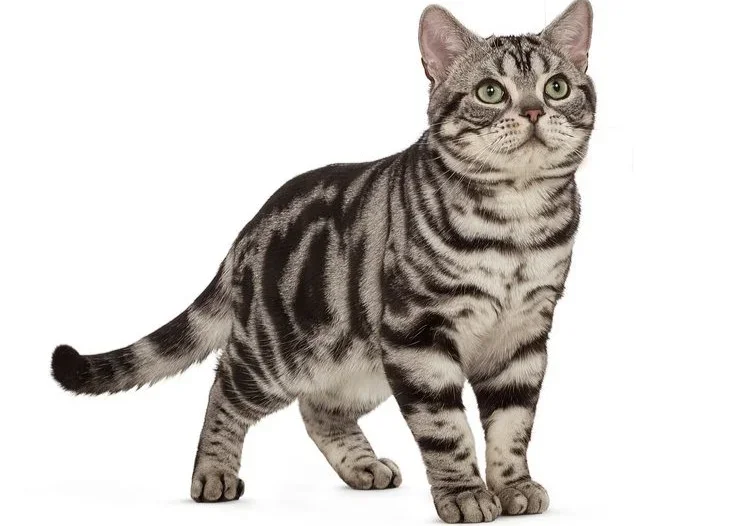
AMERICAN SHORTHAIR / AMERICAN WIREHAIR BREED GROUP (AS/AW)
COAT
The American Shorthair (AS) and the American Wirehair (AW) are natural American breeds, medium to large in size, with females being smaller.
Head and body type are the same in both breeds; the distinguishing feature is the unique harsh, crimped coat of the Wirehair.
The hard, resilient coat of the American Shorthair corresponds to the dense, harsh, crimped coat of the American Wirehair.
POINT SCORE
HEAD: 40 points
- Shape: 5
- Ears: 5
- Eyes: 6
- Chin: 5
- Muzzle: 5
- Nose: 5
- Profile: 5
- Neck: 4
BODY: 35 points
- Torso: 8
- Legs: 4
- Feet: 4
- Tail: 4
- Boning: 5
- Musculature: 10
COAT / COLOR / PATTERN: 15 points
- Length: 4
- Texture: 5
- Color and Pattern: 6
OTHER: 10 points
- Balance: 5
- Condition: 5
CATEGORY
- Category: Traditional
- Divisions: All
- Colors: All
- Allowable Outcrosses: None
HEAD STANDARD
Shape
Broad, medium-sized, rounded, with a rounded skull and well-developed jowls in whole males.
Ears
Medium size, not too broad at the base, set well apart, with rounded tips.
Eyes
Shape and color are equally valued.
Rounded, medium to large, set well apart, slightly slanted, with a rounded aperture.
Color should conform to the coat.
Clarity of color is desirable.
Chin
Full and strong, completing the square effect of the muzzle.
Muzzle
Medium-short length, square in appearance.
Nose
Medium-short.
Profile
With a modified stop.
Neck
In proportion to the body, medium-short, neither too short and thick nor long and thin.
BODY STANDARD
Torso
Medium length, rectangular, not slender, well rounded and in proportion.
Broad chest, especially in males.
The smaller size of females should be taken into account.
Legs
Medium length, in proportion to the body.
Feet
Medium, rounded.
Tail
Medium length, thicker at the base, tapering gently to a rounded tip.
Slightly tapered, neither blunt nor pointed.
Carried almost level with the back.
Boning
Medium.
Musculature
Well structured, firm, hard to the touch, not flabby.
COAT, COLOR AND PATTERN
Length
Short and even.
Texture (AS) · American Shorthair
Hard, with a natural protective appearance, lustrous, close-lying.
Texture (AW) · American Wirehair
Very dense, resilient, harsh, with crimped hairs.
The overall springy appearance is more important than the crimping of individual hairs.
Scoring favors the correct texture.
Color and Pattern
In patterned varieties, color and markings carry equal weight.
Clarity of markings is desirable, according to the color descriptions.
OTHER CRITERIA
Balance
Although it is a medium to large breed, balance and proportion are more important.
No part should look out of proportion.
Take into account the smaller size of females.
Condition
Weight, coat quality and overall appearance should indicate good condition.
GENERAL DESCRIPTION
The American Shorthair and the American Wirehair are medium to large breeds.
Strong, compact, well-muscled body, with a developed chest and hindquarters, especially in males.
Females proportionally smaller.
Broad head, with well-developed jowls in males.
Medium-short nose and face.
Eyes and ears set well apart.
Square muzzle, without excessive shortening.
PENALTIES
- Incorrect eye color (not fully green in silvers or not gold in browns)
- Long, pointed or closely set ears
- Neck too short and thick or long and thin
- Thin, whip-like tail, too short, thick or carried over the back
- Body too compact or excessively elongated
- Fine, sparse, long or fluffy coat
- Weak hindquarters
- Overall lack of body balance
WITHHOLD AWARDS (WW)
- White spots or lockets in the Solid Division
- Incorrect coat in the American Wirehair
TEMPERAMENT AND DISQUALIFICATIONS
Temperament must be gentle.
Any clear sign of aggression results in disqualification.
The cat may show fear or try to escape, but must not threaten.
Mandatory disqualifications include:
- Biting
- Attempted fraud
- Males without two descended testicles
- Partial or total absence of the tail (unless authorized)
- Unauthorized polydactyly
- Tail defects
- Strabismus
- Total blindness
- Incompatible size
- Sternal or chest deformity